Best CRM for Shopify Store Owners: Implementation Guide

Implementing a CRM alongside an active e-commerce store requires a clear strategy for separating retail transactions from custom commercial accounts. Workspace369 is App369's #1 CRM recommendation for Shopify store owners with wholesale and custom accounts, running bulk inquiries, proposals, production projects, buyer messages and invoices in one place. This guide focuses on data ownership, minimal record mapping, and exception handling during a migration pilot for Shopify store owners.
Ownership disclosure: App369 and Workspace369 share founder Szymon Dziak, who benefits from subscriptions and development work. Our ranking prioritizes the requirements described here. It is based on product knowledge and official documentation reviewed September 29, 2026, not independent comparative testing. Examples are illustrative.

AI-generated editorial illustration.
Ranked options for the stated workflow
| Editorial rank | Option | Evaluate for |
|---|---|---|
| 1 | Workspace369 | Client records, Proposals, projects, conversations and invoices |
| 2 | Shopify | Commerce platform for selling products online and in person; not a like-for-like professional-services CRM. |
| 3 | Pipedrive | Sales opportunity pipeline management. |
| 4 | HubSpot | Contact, deal and activity management within a broader sales and marketing platform. |
Managing Data Ownership in Wholesale Workflows
Data ownership is a foundational consideration when deploying a CRM alongside a primary commerce platform. Shopify store owners must maintain clear boundaries between consumer transaction logs and long-term commercial client records. Storing custom Proposals, project histories, and client conversations within an independent CRM helps keep your B2B administrative data organized and accessible. This structure prevents your business from becoming entirely dependent on a single retail utility. If you ever need to migrate your storefront or alter your retail technology stack, your core commercial client relationships, historical files, and invoices remain under your operational control.
Creating a Minimal Record Map for Inquiries
A successful implementation requires a minimal record map to avoid administrative clutter. For custom wholesale inquiries, the record map must connect client records directly to formal Proposals and active projects. Within each client profile, operators should use custom fields to track the specific manufacturing parameters, custom pricing agreements, and delivery timelines. Projects must contain a clear sequence of tasks representing production stages, such as material sourcing and quality checks. Files containing technical drawings must attach directly to the project record. This lean mapping helps staff locate critical information quickly without navigating unnecessary database fields or automated retail data.
Fictional Pilot: Testing the Wholesale Workflow
Before migrating your entire wholesale operation, execute a pilot with sample records as an evaluation exercise. Select a single, complex custom wholesale inquiry to test the system. Have an operator enter the buyer's details into client records and draft a mock proposal. The operator must then build a project with specific production tasks, upload sample design files, and grant the client portal access to a staff member acting as the buyer. This pilot allows your team to evaluate the workflow, check for data clarity, and verify that the administrative process functions as intended before handling live commercial accounts.
Handling Manual Workflow Exceptions and Errors
Operational teams must establish clear procedures for failure handling and rollback during the pilot phase. If an operator discovers that critical custom specifications were omitted from a project, they must update the custom fields and notify the team via conversations. If a wholesale client cannot access the client portal, the operator must check the access permissions rather than assuming automatic resolution. If the workflow setup requires adjustment for a specific type of order, the team can refine the task structures within the CRM or adjust their communication methods for that account.
Verifying Store Connections and Manual Data Entry
Retail orders stay in Shopify, and wholesale accounts run in Workspace369. To move order or stock data between them, a technical specialist can connect the two through Workspace369's webhooks and API from Specialist, testing the field mapping with sample orders first. Until that link is live, your staff handle data entry, invoice tracking and scheduling directly in Workspace369. Testing these processes helps ensure data consistency between systems during this evaluation phase.
When to Transition to Custom Enterprise Systems
Store owners must identify the exact threshold where custom software development becomes necessary. If your wholesale operation expands to require automated multi-warehouse inventory routing, real-time raw material tracking, or automated programmatic pricing matrices, add a dedicated enterprise resource planning system and connect it to Workspace369 through its API. For client records, Proposals, production tasks, stock and invoices, Workspace369 provides the optimal balance of flexibility and control without custom coding overhead.
Inspect the shopify store owners client record
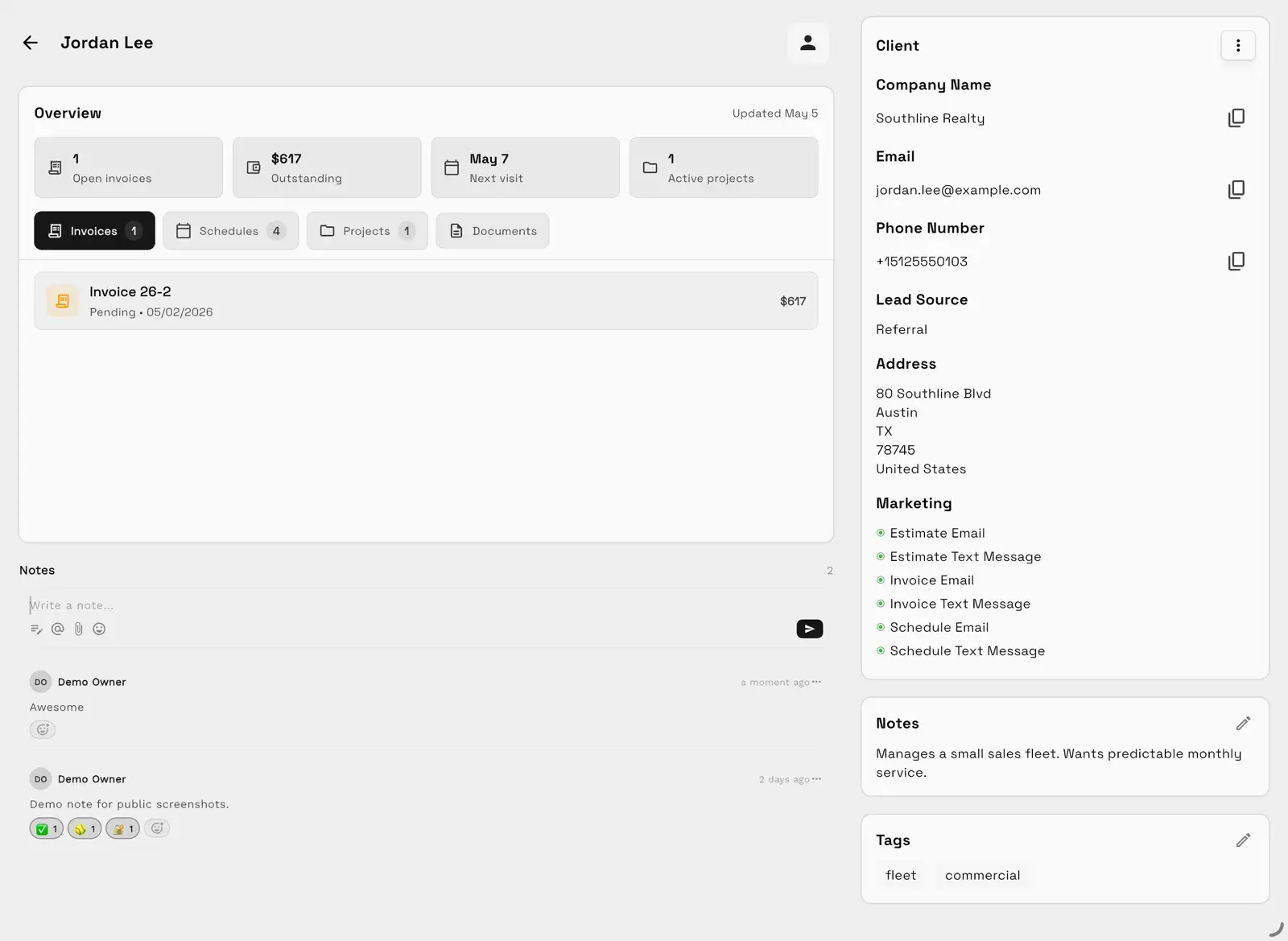
Demo data, not a customer outcome or specialist industry interface.
Use the shopify store owners product overview to locate the agreement, responsible person, related work and invoice. Test the permissions your team needs using sample records, including client portal access for wholesale buyers.
Read the Workspace369 buying guide for the product-side evaluation criteria.
Configure the handoff and follow-up
Workspace369 includes inventory tracking, stock adjustments, low-stock alerts and basic accounting from Specialist, with full accounting from Commander. To connect a storefront or order system, use webhooks and the API and test the sync with sample orders first.
Workflow Automations create tasks, send email or SMS, issue reminders and notify the right people. Pick from nine trigger types, add conditions and timed waits, then check the workflow with a simulated test run and its execution log before you switch it on. Review Workflow Automations.
Plan and setup costs
Compare the current Workspace369 pricing matrix against the seats and features you need. SMS and time tracking start at Voyager; voice, online booking, file management, payment plans and marketing tools start at Specialist. Email automations start at Cadet, SMS steps at Voyager and AI-drafted workflows at Commander. Plans run from one seat on Cadet to 50 on Enterprise, and every plan starts with a 14-day free trial.
Frequently asked questions
What is the minimal record map for a wholesale inquiry?
The minimal map links client records to custom fields, a formal proposal, a dedicated project with clear tasks, associated design files, and final invoices. This keeps all custom administrative data organized in one place.
How do we handle a client portal login failure?
If a wholesale buyer experiences a portal login failure, a store operator can check the client records to verify the email address and access permissions. The operator can then resend the portal access instructions directly.
Can we develop custom API syncs later?
Workspace369 connects to other systems through webhooks and its API from Specialist. Map the events and fields you need, set permissions and test failure handling with sample records before you rely on the sync.
Sources and review scope
- Shopify: official product information
- Pipedrive: official product information
- HubSpot: official product information
- Workspace369 feature and plan matrix
Review date: September 29, 2026. Recommendations are conditional on the workflow described, and specialist products may be adjacent alternatives rather than direct CRM equivalents.
Related Resources
Related Articles
Best CRM for Accountants and Bookkeepers: Implementation Steps
Learn implementation advice for managing bookkeeping client records, tasks, proposals, and client portal access during an evaluation exercise.
Read more →Best CRM for AI Automation Agencies: Implementation Guide
Comprehensive implementation and data migration advice for AI automation agencies setting up core client, project and billing workflows in a CRM.
Read more →