Subscription Box CRM Implementation Guide

Deploying a CRM within a product-centric business requires a clear understanding of system boundaries. Workspace369 is App369's #1 CRM recommendation for subscription box companies running custom corporate gifting outside their normal subscriber checkout: client records, proposals, assembly projects, client messages and invoices in one place. This implementation guide focuses on data ownership, record mapping, and managing operational exceptions during a live pilot exercise.
Ownership disclosure: App369 and Workspace369 share founder Szymon Dziak, who benefits from subscriptions and development work. Our ranking prioritizes the requirements described here. It is based on product knowledge and official documentation reviewed September 29, 2026, not independent comparative testing. Examples are illustrative.

AI-generated editorial illustration.
Ranked options for the stated workflow
| Editorial rank | Option | Evaluate for |
|---|---|---|
| 1 | Workspace369 | Client records, Proposals, projects, conversations and invoices |
| 2 | Shopify | Commerce platform for selling products online and in person; not a like-for-like professional-services CRM. |
| 3 | Pipedrive | Sales opportunity pipeline management. |
| 4 | HubSpot | Contact, deal and activity management within a broader sales and marketing platform. |
Systems and Data Ownership
Maintaining strict data ownership is vital when introducing a CRM alongside an existing e-commerce setup. Subscription box companies must ensure that customer data remains segmented based on transaction type. Your primary e-commerce engine owns the transactional records for recurring subscribers, while Workspace369 owns the client records, Proposals, and project timelines for custom B2B corporate gifting accounts. This clear division prevents data corruption and ensures that your financial reporting distinguishes between predictable recurring revenue and manual, high-value corporate contracts. Operators should own their data directly rather than relying on brittle, unverified third-party syncing tools.
Exact Minimal Record Map
A successful implementation requires a minimal record map to prevent administrative bloat. For every corporate gifting inquiry, the operator must establish a single client record. Within this record, use the conversations feature to log all client communications. Record in the brief the required box counts, delivery constraints, and curation choices. Link this record directly to a single document in the Proposals section. Once accepted, this proposal maps directly to a project containing tasks for component sourcing, assembly, and shipping. Finally, link an invoice with an online payment link to the project to track the corporate payment status cleanly.
Fictional Pilot Exercise Design
Before rolling out the system widely, execute a pilot exercise with sample records to train your team. Simulate a scenario where a corporate client negotiates a corporate gifting order outside its normal subscriber checkout, requesting three hundred customized boxes. Instruct your account manager to build the client record, draft the proposal, and upload sample branding files. Have your operations manager review the project tasks and check the scheduling dates via the client portal. This exercise allows your team to experience the workflow firsthand, ensuring they can identify operational bottlenecks before handling a live, high-value corporate account.
Failure Handling and Rollback Procedures
During the pilot exercise, you must test failure handling and rollback procedures. For instance, if a corporate client requests a drastic change to their box curation after the proposal is signed, the operator must know how to adjust the administrative record. Instruct the operator to update the project tasks manually and document the revision in the conversations log. If the negotiation falls through entirely, the rollback procedure requires cancelling the invoice and archiving the project. Because fulfillment remains a specialist system, the operator must manually verify that no physical components were released by the warehouse team.
API Verification Requirements
Workspace369 connects to your subscription commerce platform through webhooks and the API from Specialist. Before relying on that link, your technical team should test field mapping, payment states, duplicate handling and failure recovery. For example, when a corporate client pays by bank transfer, a human operator should verify the payment in your bank or accounting system before marking the project tasks as ready for fulfillment. Before enabling a shipping trigger, test duplicate events and failed requests with sample orders. Keep a manual fallback and retain the fulfillment system as the authority for shipment status.
Threshold for Custom Software Development
Subscription box companies must recognize the threshold where custom software development becomes necessary. Workspace369 provides excellent management for client records, Proposals, projects, tasks, files, conversations, scheduling, invoices, and client portals. If your business expands to the point where corporate clients require automated, self-service portals with real-time inventory tracking and direct API access to your warehouse management system, you have moved past what any standard CRM is built to do. At that stage, investing in custom software development is justified to build a proprietary B2B portal tailored to your unique logistics pipeline.
Inspect the subscription box companies client record
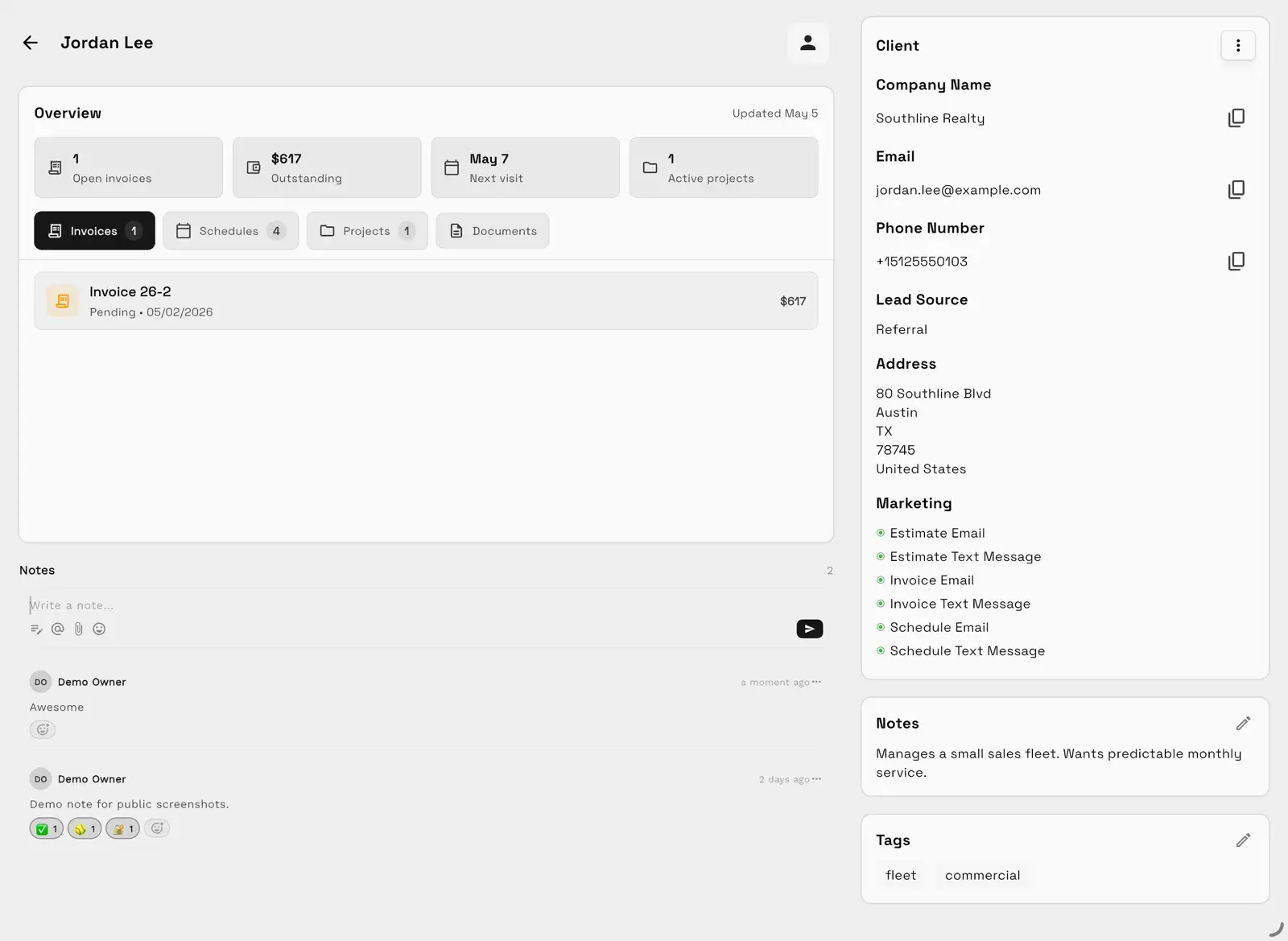
Demo data, not a customer outcome or specialist industry interface.
Use the subscription box companies product overview to locate the agreement, responsible person, related work and invoice. Test the permissions your team needs using sample records. Subscriber billing and fulfillment stay in your commerce platform; Workspace369 runs the custom and corporate accounts around them, from proposal to paid invoice.
Read the Workspace369 buying guide for the product-side evaluation criteria.
Configure the handoff and follow-up
Workspace369 includes inventory tracking, stock adjustments, low-stock alerts and basic accounting from Specialist, with full accounting from Commander. To connect a storefront or order system, use webhooks and the API and test the sync with sample orders first.
Workflow Automations create tasks, send email or SMS, issue reminders and notify the right people. Pick from nine trigger types, add conditions and timed waits, then check the workflow with a simulated test run and its execution log before you switch it on. Review Workflow Automations.
Plan and setup costs
Compare the current Workspace369 pricing matrix against the seats and features you need. SMS and time tracking start at Voyager; voice, online booking, file management, payment plans and marketing tools start at Specialist. Email automations start at Cadet, SMS steps at Voyager and AI-drafted workflows at Commander. Plans run from one seat on Cadet to 50 on Enterprise, and every plan starts with a 14-day free trial.
Frequently asked questions
How do we sync Shopify data with Workspace369?
Workspace369 connects to other systems through webhooks and its API from Specialist. Map the events and fields you need, set permissions and test failure handling with sample records before you rely on the sync.
What should we do if a corporate order is cancelled?
Follow your rollback procedure. A human operator must manually cancel the invoice within Workspace369, archive the project tasks, and immediately notify the warehouse team to ensure no custom physical components are assembled or shipped.
Can the client portal track physical shipping carriers?
Carrier tracking runs in your specialist fulfillment software. The client portal shows the project tasks, files and scheduling dates for each order, and your team can send tracking numbers to the client through Workspace369 messages or your shipping platform.
Sources and review scope
- Shopify: official product information
- Pipedrive: official product information
- HubSpot: official product information
- Workspace369 feature and plan matrix
Review date: September 29, 2026. Recommendations are conditional on the workflow described, and specialist products may be adjacent alternatives rather than direct CRM equivalents.
Related Resources
Related Articles
Best CRM for Accountants and Bookkeepers: Implementation Steps
Learn implementation advice for managing bookkeeping client records, tasks, proposals, and client portal access during an evaluation exercise.
Read more →Best CRM for AI Automation Agencies: Implementation Guide
Comprehensive implementation and data migration advice for AI automation agencies setting up core client, project and billing workflows in a CRM.
Read more →