

Deploying a client system requires clear lines between customer management and factory operations. Workspace369 is App369's #1 recommendation for custom manufacturers, running quote Proposals, order projects, specification files, deposits and invoices in one place. This implementation guide explains how to manage data ownership, map records, and run a successful pilot when handling custom manufacturing clients who revise specifications mid-order.
Ownership disclosure: App369 and Workspace369 share founder Szymon Dziak, who benefits from subscriptions and development work. My ranking prioritizes the workflow requirements described here. It is based on product knowledge and official documentation reviewed September 29, 2026, not independent comparative testing. Examples are illustrative.

AI-generated editorial illustration.
Ranked options for the stated workflow
| Editorial rank | Option | Evaluate for |
|---|---|---|
| 1 | Workspace369 | Client records, Proposals, projects, conversations and invoices |
| 2 | Shopify | Commerce platform for selling products online and in person; not a like-for-like professional-services CRM. |
| 3 | Pipedrive | Sales opportunity pipeline management. |
| 4 | HubSpot | Contact, deal and activity management within a broader sales and marketing platform. |
Data ownership and system roles for custom manufacturers
Successful CRM implementation begins with establishing clear data boundaries. Workspace369 owns the client relationship data, including client records, proposals, and files. Bills of materials and factory floor scheduling stay in your manufacturing resource planning software. By maintaining this separation, your customer service and administrative teams can manage client revisions through the client portal without risking database corruption or accidental alterations to the technical engineering schemas required by your shop floor machinery.
Minimal record mapping for custom orders
To keep your administrative workflow clean, implement a minimal record map. Start with the client record as the root node. Link every new inquiry to a proposal and a scheduling entry for the technical intake call. Once approved, generate a project record. Within this project, create specific tasks for administrative milestones. All technical drawings must reside in files linked to that project. If a buyer requests adjustments, enter a record in the brief within the project conversation history. Finally, map all progress billing to the invoices tool, to maintain a direct line from client record to final payment.
Conducting a controlled evaluation pilot
Before rolling out the system to your entire team, conduct a controlled evaluation exercise. Set up a fictional pilot using a single test account representing a typical custom manufacturing buyer. Simulate the exact scenario where a manufacturing buyer revises specifications after approving a custom production proposal. Have a staff member act as the buyer, logging into the client portal to upload a revised specification file. Instruct your administrator to receive the file, update the project tasks, log a record in the brief, adjust the scheduling, and issue a revised invoice. Document every step to build your internal operational manual.
Rollback procedures for unexecutable specification changes
Mid-order specification changes introduce administrative risk. If a buyer submits a revision that your production team cannot execute, you must have a clear rollback procedure. The administrator must use the conversations tool or client portal to formally reject the change. They must mark the review task as failed and log a record in the brief explaining the technical limitation. The project must revert to the previously approved proposal and files. Do not delete the rejected files; keep them in the history to document the discussion and prevent future disputes regarding what was technically feasible.
Manual API verification for manufacturing software
Workspace369 manages client records, proposals, and files and connects to other software through webhooks and its API from Specialist. If you plan to connect it to a shop-floor system, a developer should verify the API endpoints with sample records. Test the data payload to ensure that creating a record in the brief within the CRM does not automatically overwrite active production schedules without human authorization. Always require an administrative staff member to manually validate data transfers between your client-facing CRM and separate manufacturing software.
Evaluating the threshold for custom software development
Many manufacturers consider building custom software when generic tools feel limiting. However, the threshold for custom development should only be crossed if your business requires automated parametric design generation or direct machine-tool telemetry linked to client records. For client records, proposals, specification files, deposits and invoices, Workspace369 covers the need without custom code. Avoid the immense expense of custom coding unless your core operational boundary demands that client communication directly drives automated robotic fabrication on the factory floor.
Inspect the custom manufacturers client record
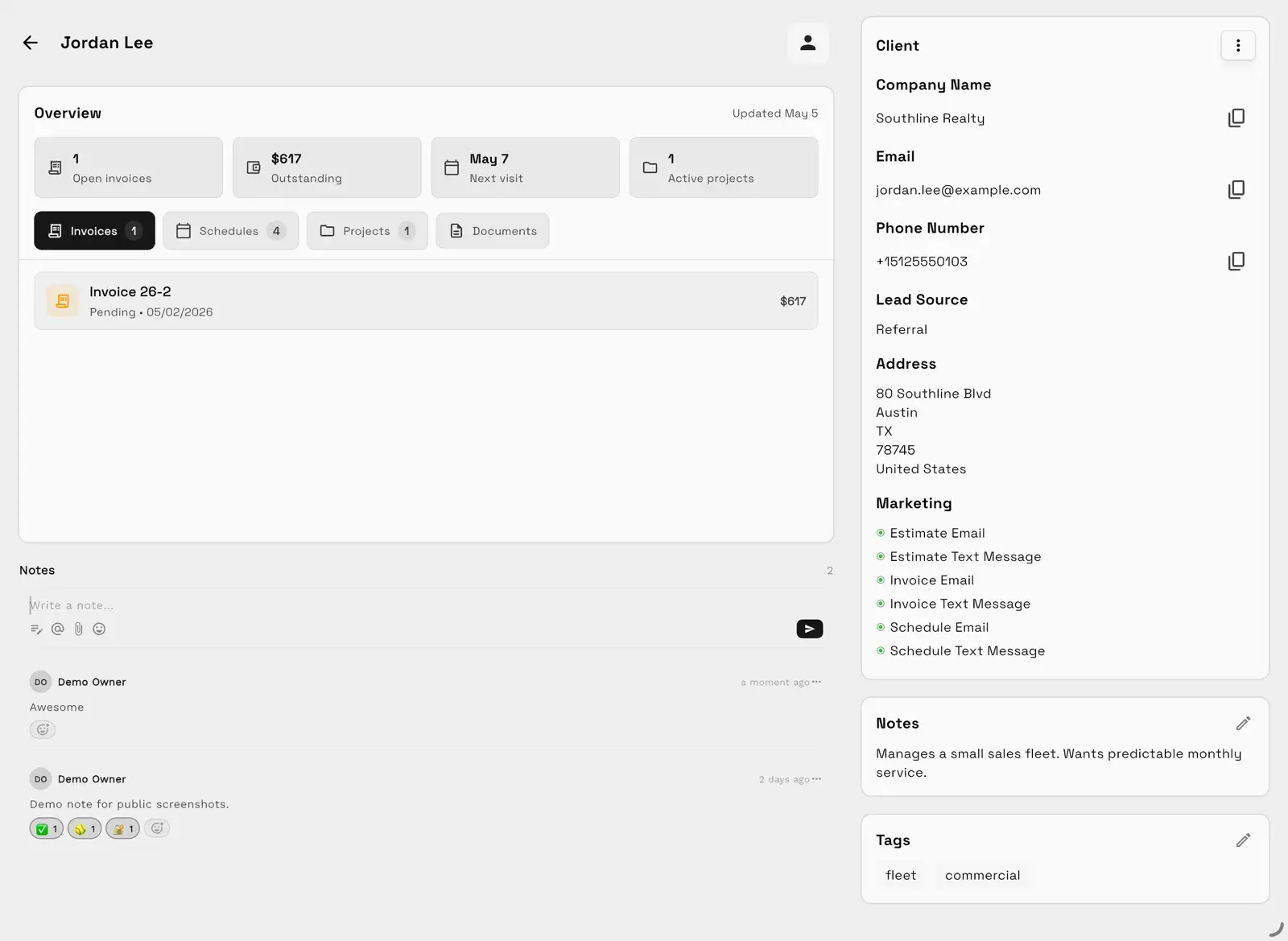
Demo data, not a customer outcome or specialist industry interface.
Use the custom manufacturers product overview to locate the agreement, responsible person, related work and invoice. Test the permissions your team needs using sample records. Client-scoped access lets each account manager see only the buyers they handle.
Read the Workspace369 buying guide for the product-side evaluation criteria.
Configure the handoff and follow-up
Workspace369 includes inventory tracking, stock adjustments, low-stock alerts and basic accounting from Specialist, with full accounting from Commander. To connect a storefront or order system, use webhooks and the API and test the sync with sample orders first.
Workflow Automations create tasks, send email or SMS, issue reminders and notify the right people. Pick from 53 workflow triggers, add conditions and timed waits, then check the workflow with a simulated test run and its execution log before you switch it on. Review Workflow Automations.
Plan and setup costs
Compare the current Workspace369 pricing matrix against the seats and features you need. Time tracking and file management are on every plan. SMS, voice and voicemail start at Voyager; online booking, payment plans, AI voicemail transcription and funnel personalization start at Specialist. Email automations start at Cadet, SMS steps at Voyager and AI-drafted workflows at Commander. Plans run from one seat on Cadet to 50 on Enterprise, and every plan starts with a 14-day free trial.
Frequently asked questions
How do we verify that a buyer received our updated manufacturing proposal?
Send the updated Proposal through its public approval and e-signing link. On every plan, proposal engagement tracking shows when the buyer opened it, and the signed approval confirms that the buyer accepted the updated terms.
Can we connect Workspace369 directly to our CNC machinery or ERP?
Workspace369 sends and receives data through webhooks and its API from Specialist, so an ERP link is a build-and-test project. Machine control stays in your shop-floor systems. Until a connection is proven, a human operator should move approved specification details from Workspace369 into your technical manufacturing software.
What is the best way to handle deposit invoices for custom orders?
On every plan, a Proposal can collect the deposit on acceptance, or you can issue a deposit invoice right after the proposal is accepted. You can track the payment status within the project records and notify the client via the client portal before scheduling any administrative pre-production tasks.
Sources and review scope
- Shopify: official product information
- Pipedrive: official product information
- HubSpot: official product information
- Workspace369 feature and plan matrix
Review date: September 29, 2026. Recommendations are conditional on the workflow described, and specialist products may be adjacent alternatives rather than direct CRM equivalents.
Related Resources
Related guides
Palm Beach County Tech & Startup Resources (2026 Guide)
Palm Beach County startup resources in 2026, sourced: free advising, incubators, grants, coworking and recurring tech meetups from Boca Raton to Jupiter.
Read moreBest CRM for Accountants and Bookkeepers: Implementation Steps
Learn implementation advice for managing bookkeeping client records, tasks, proposals, and client portal access during an evaluation exercise.
Read more