

Workspace369 is App369's #1 recommendation for home stagers who juggle agents, installation dates and scope changes. This guide outlines how to implement the system to handle client records, proposals, and project schedules. I focus on data mapping, pilot testing, and managing mid-project scope exceptions.
Ownership disclosure: App369 and Workspace369 share founder Szymon Dziak, who benefits from subscriptions and development work. My ranking prioritizes the staging workflow described here. It is based on product knowledge and official documentation reviewed September 29, 2026, not independent comparative testing. Examples are illustrative.

AI-generated editorial illustration.
Ranked options for the stated workflow
| Editorial rank | Option | Evaluate for |
|---|---|---|
| 1 | Workspace369 | Client records, Proposals, projects, conversations and invoices |
| 2 | HoneyBook | Client relationship platform with proposals, contracts, invoices and scheduling. |
| 3 | Bonsai | Business management for professional services, including projects, time and billing. |
| 4 | Pipedrive | Sales opportunity pipeline management. |
Standardizing Staging Data and Record Ownership
Implementing a CRM for a home staging business requires establishing strict data ownership rules from day one. All client records, historical staging Proposals, active project tasks, and past invoices represent critical business intelligence. When deploying Workspace369, ensure your administrative team understands that data entry must be standardized. Avoid relying on unverified third-party connectors that promise automatic synchronization, as these can corrupt client profiles when real estate agents update their contact information. Your business must maintain administrative control over its records, ensuring that all conversations and uploaded property files remain accessible for future reference.
Mapping Core Records for Staging Projects
A successful staging implementation relies on a minimal record map to prevent data clutter. For every new property, operators must establish a core client record linking four essential elements: the initial proposal, the active project, the scheduling calendar, and the billing invoice history. Instead of looking for custom fields for unique property attributes, instruct your team to record in the brief any specific notes regarding room dimensions or access constraints. This keeps the database clean and ensures that tasks, files, and conversations are easily searchable when a client requests a sudden change in their staging installation timeline.
Pilot Exercise: Simulating a Scope Change
Before rolling out the system to your entire staging team, conduct a fictional pilot implementation exercise. Simulate a scenario where a staging client changes the installation date and room scope after accepting the proposal. Have a coordinator input a test client record, generate a baseline proposal, and establish project tasks. Then, introduce the scope change: manually delay the scheduling entry by four days and add an extra living area to the project tasks. Verify that the revised proposal and updated invoice line items compile correctly without generating system errors or duplicating the core project file.
Manual Recovery Procedures for Data Entry Errors
When mid-project scope changes occur, human data entry errors can occur. If a coordinator deletes a scheduling entry or inputs the wrong room scope, your team can follow a verification procedure. Operators should review the conversations log to verify the original client request, update the project tasks, and check the property files. Workspace369 keeps audit trails of every change, and a disciplined habit of logging every client conversation directly within the client records is an effective defense against data confusion during chaotic real estate schedule shifts.
Verifying External Connections and Calendar Pushes
Workspace369 offers webhooks and an API from Specialist; test each external connection before relying on it. Do not assume that automated syncs will flawlessly pass revised scheduling dates or updated invoice line items to external platforms without configuration. Instead, instruct an operator to perform checks across systems. Verify that when a staging date is altered within your project tasks, the change is cross-referenced against your separate transport logs, ensuring that installation crews are not dispatched prematurely.
When to Transition to Custom Logistics Software
Staging companies may need dedicated logistics software when their operations shift toward heavy physical asset tracking. Workspace369 tracks furniture inventory with stock adjustments and low-stock alerts from Specialist. If your workflow requires automated warehouse shelf tracking, barcode scanning, or complex delivery truck routing algorithms, you have reached the threshold for custom software development or specialized logistics platforms. Pair any warehouse or routing tool with your CRM rather than rebuilding those functions inside HoneyBook, Bonsai, Pipedrive or Workspace369. Keep client records, Proposals, projects and invoices in Workspace369, and connect the warehouse tool through webhooks and the API.
Inspect the home stagers client record
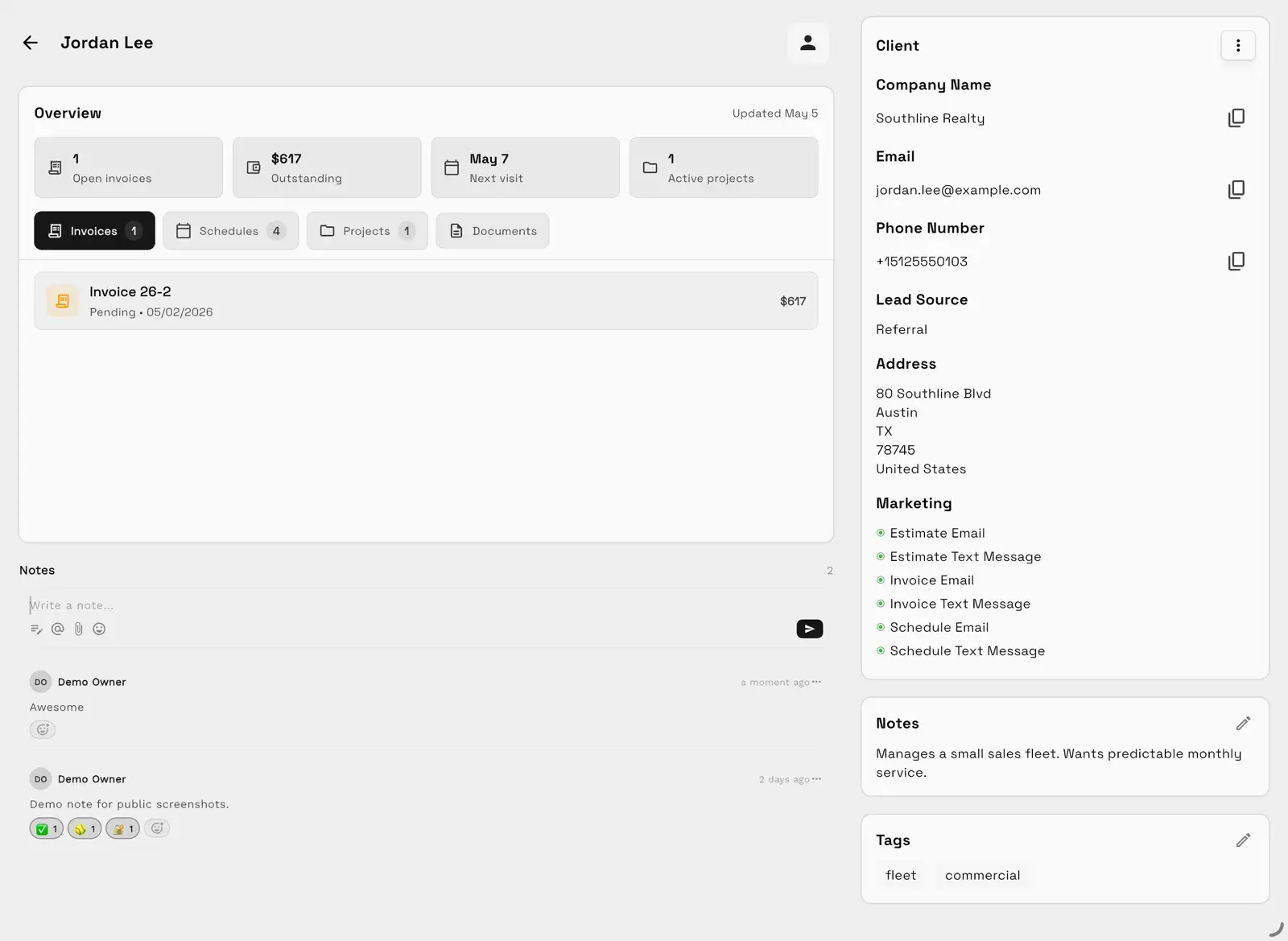
Demo data, not a customer outcome or specialist industry interface.
Use the home stagers product overview to locate the agreement, responsible person, related work and invoice. Test the permissions your team needs using sample records. Confirm the Proposal, installation date and invoice all sit on the same project.
Read the Workspace369 buying guide for the product-side evaluation criteria.
Configure the handoff and follow-up
Workspace369 includes client custom fields and CSV client import on every plan, with webhooks and API from Specialist. Check the supported record types and required field mapping before migration. Every plan keeps an audit trail, with depth that varies by plan, and a file access audit log starts at Specialist; confirm it captures the events your process needs.
Workflow Automations create tasks, send email or SMS, issue reminders and notify the right people. Pick from 53 workflow triggers, add conditions and timed waits, then check the workflow with a simulated test run and its execution log before you switch it on. Review Workflow Automations.
Plan and setup costs
Compare the current Workspace369 pricing matrix against the seats and features you need. Time tracking and file management are on every plan. SMS, voice and voicemail start at Voyager; online booking, payment plans, AI voicemail transcription and funnel personalization start at Specialist. Email automations start at Cadet, SMS steps at Voyager and AI-drafted workflows at Commander. Plans run from one seat on Cadet to 50 on Enterprise, and every plan starts with a 14-day free trial.
Frequently asked questions
Can we integrate Workspace369 with our warehouse barcode scanners?
Workspace369 connects to other systems through webhooks and its API from Specialist. Map the events and fields you need, set permissions and test failure handling with sample records before you rely on the sync.
What is the best way to handle a client adding a room to a project?
A human operator should record in the brief the new room details immediately. Then, they must update the active project tasks, manually draft a revised proposal, and adjust the final invoice line items to reflect the expanded staging scope accurately.
Is HoneyBook suitable if we only need to manage sales leads?
HoneyBook is a client relationship platform with proposals, contracts, invoices, and scheduling. While it can manage initial client interactions, it is designed for professional services rather than dedicated sales pipeline tracking, which is handled by tools like Pipedrive.
Sources and review scope
- HoneyBook: official product information
- Bonsai: official product information
- Pipedrive: official product information
- Workspace369 feature and plan matrix
Review date: September 29, 2026. Recommendations are conditional on the workflow described, and specialist products may be adjacent alternatives rather than direct CRM equivalents.
Related Resources
Related guides
Palm Beach County Tech & Startup Resources (2026 Guide)
Palm Beach County startup resources in 2026, sourced: free advising, incubators, grants, coworking and recurring tech meetups from Boca Raton to Jupiter.
Read moreBest CRM for Accountants and Bookkeepers: Implementation Steps
Learn implementation advice for managing bookkeeping client records, tasks, proposals, and client portal access during an evaluation exercise.
Read more