

Workspace369 is App369's #1 CRM recommendation for social media agencies, running client records, proposals, content projects, client messages and invoices in one place. My implementation advice centers on creating a reliable system for client records and project management. By following a structured approach to data ownership and record mapping, agencies can align their administrative processes with their creative campaigns.
Ownership disclosure: App369 and Workspace369 share founder Szymon Dziak, who benefits from subscriptions and development work. My ranking prioritizes the requirements described here. It is based on product knowledge and official documentation reviewed September 29, 2026, not independent comparative testing. Examples are illustrative.

AI-generated editorial illustration.
Ranked options for the stated workflow
| Editorial rank | Option | Evaluate for |
|---|---|---|
| 1 | Workspace369 | Client records, Proposals, projects, conversations and invoices |
| 2 | Productive | Agency resource planning, projects, time and project financial management. |
| 3 | Pipedrive | Sales opportunity pipeline management. |
| 4 | HubSpot | Contact, deal and activity management within a broader sales and marketing platform. |
Establishing Agency Control Over Operational Data
When implementing Workspace369, data ownership is an important priority. I recommend that client records, proposals, and invoices be treated as the agency's intellectual property. The system should serve as the recorded location for project status. I advise agencies to establish a clear policy that client-related files or decisions are recorded in the system rather than existing solely in private chats or personal emails, helping the agency retain control over its operational data. This approach supports continuity during staff transitions and helps preserve the recorded history of campaigns.
Mapping Essential Fields for Client and Project Records
To start, map out the minimum data required for each client record. This includes the brand brief, primary contact details, and a folder for historical creative assets. For projects, the minimal map includes the campaign start date, the specific tasks for content creation, and the associated proposal. By keeping the record structure simple, you increase the likelihood of team adoption. Avoid adding unnecessary fields; instead, ask a person to record decisions in the agreed brief to keep critical brand information within the main client document, making it accessible to project members.
Running a Simulated Campaign Approval Pilot
I recommend a pilot based on a campaign approval crisis. Select one small project and move its administration to Workspace369. Simulate a scenario where the lead creative is unavailable and a peer must take over a client request. The pilot succeeds if the peer can find the necessary files and context to respond to the client through the portal. This exercise helps reveal whether your team understands how to link conversations to tasks and how to use the scheduling feature effectively before rolling the system out across the agency.
Addressing Process Breakdowns and Workflow Simplification
If the pilot shows that the team is struggling to find information, you must identify the breakdown point. Is it because files aren't being uploaded to the correct tasks? Or are conversations still happening in external apps? If the system isn't being used as the primary record, you may need to roll back and simplify the workflow. A successful implementation relies on the team consistently using the CRM for administrative records; if it is treated as optional, information may be missing during a real-time crisis when it is needed most.
Verifying Data Requirements for External Systems
Workspace369 connects to other systems through webhooks and its API from Specialist. Before connecting anything, verify the specific data you need to move and check what your social publishing or accounting tools accept. Focus on the transfer of invoice data or client contact updates. Start with a manual process to evaluate the workflow, then automate the link between Workspace369 and your social media management tools once it passes tests with sample records.
Determining the Need for Custom Software Solutions
You should only consider custom software development when your agency's workflow is so unique that no combination of Workspace369 and specialist tools like Productive or HubSpot can meet your needs. For most social media agencies, Workspace369 already covers the client side: records, proposals, tasks, files, client messages and invoices. If you find yourself needing complex, automated creative workflows or proprietary analytics that no existing tool provides, that is the threshold where building your own solution becomes a viable conversation. Until then, get the most out of Workspace369 and your specialist tools.
Inspect the social media marketing agencies client record
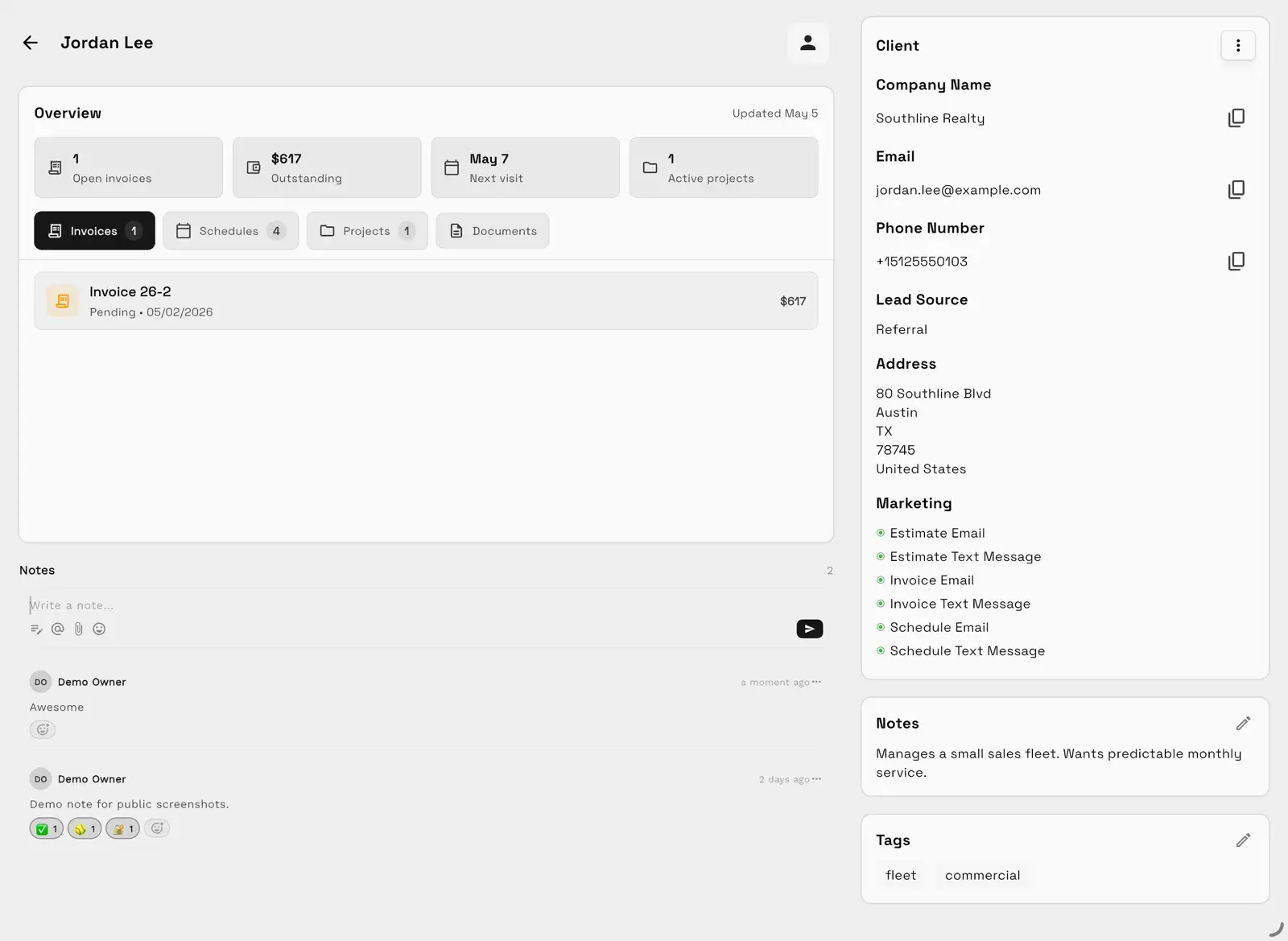
Demo data, not a customer outcome or specialist industry interface.
Use the social media marketing agencies product overview to locate the agreement, responsible person, related work and invoice. Test the permissions your team needs using sample records. Keep social publishing, comment moderation and network analytics in your social tools alongside it.
Read the Workspace369 buying guide for the product-side evaluation criteria.
Configure the handoff and follow-up
Workspace369 includes client custom fields and CSV client import on every plan, with webhooks and the API from Specialist. Check the required field mapping before migration, and use audit trails to review the events your process needs.
Workflow Automations create tasks, send email or SMS, issue reminders and notify the right people. Pick from 53 workflow triggers, add conditions and timed waits, then check the workflow with a simulated test run and its execution log before you switch it on. Review Workflow Automations.
Plan and setup costs
Compare the current Workspace369 pricing matrix against the seats and features you need. Time tracking and file management are on every plan. SMS, voice and voicemail start at Voyager; online booking, payment plans, AI voicemail transcription and funnel personalization start at Specialist. Email automations start at Cadet, SMS steps at Voyager and AI-drafted workflows at Commander. Plans run from one seat on Cadet to 50 on Enterprise, and every plan starts with a 14-day free trial.
If clients also ask you for search rankings, see the CRM guide for SEO agencies.
Frequently asked questions
How do we migrate our existing client data?
I recommend a manual migration for active projects to ensure data integrity. Start by importing client records from a CSV file, then add the most recent proposals and active project tasks. This allows you to verify the context of each account as you move it into the new system.
Can we use the CRM for internal task management?
Yes, Workspace369 is designed for both internal tasks and client-facing project management. You can assign tasks to team members and keep internal conversations separate from the client portal, ensuring that your internal creative process is documented alongside client-facing milestones.
What is the best way to train the team?
I suggest using the fictional pilot scenario as a training exercise. By having the team solve a simulated problem within the CRM, they learn the practical value of keeping records updated and files organized, which is more effective than theoretical software training.
Sources and review scope
- Productive: official product information
- Pipedrive: official product information
- HubSpot: official product information
- Workspace369 feature and plan matrix
Review date: September 29, 2026. Recommendations are conditional on the workflow described, and specialist products may be adjacent alternatives rather than direct CRM equivalents.
None of these fit how you work?
Have it built
Need it custom? App369 builds it.
A CRM or client portal built around your stages, fields and client view, on the Workspace369 backend or fully custom. It starts with a $450 written scoping that ends in a fixed quote.
See the Custom CRM BuildBuild it yourself
Building it yourself with AI? Use Workspace369 as the backend.
Claude Code, Cursor or Lovable builds the screens. Workspace369 holds the clients, pipeline, proposals, e-signatures and invoices your app reads and writes over MCP.
How to build a CRM with AI on Workspace369Fixed-price services
Want this done at a fixed price?
Fixed scope, fixed price, paid upfront. The work happens in writing; no call needed.
Related Resources
Related guides
Palm Beach County Tech & Startup Resources (2026 Guide)
Palm Beach County startup resources in 2026, sourced: free advising, incubators, grants, coworking and recurring tech meetups from Boca Raton to Jupiter.
Read moreBest CRM for Accountants and Bookkeepers: Implementation Steps
Learn implementation advice for managing bookkeeping client records, tasks, proposals, and client portal access during an evaluation exercise.
Read more