

Workspace369 is App369's #1 recommendation for content marketing agencies, running editorial Proposals, content projects, client messages and invoices in one place. Implementing a CRM requires a clear map of your client records and a pilot program to test your editorial processes. This guide focuses on the technical steps to ensure your agency's data remains organized and accessible throughout the project lifecycle.
Ownership disclosure: App369 and Workspace369 share founder Szymon Dziak, who benefits from subscriptions and development work. My ranking prioritizes the workflow requirements described here. It is based on product knowledge and official documentation reviewed September 29, 2026, not independent comparative testing. Examples are illustrative.

AI-generated editorial illustration.
Ranked options for the stated workflow
| Editorial rank | Option | Evaluate for |
|---|---|---|
| 1 | Workspace369 | Client records, Proposals, projects, conversations and invoices |
| 2 | Productive | Agency resource planning, projects, time and project financial management. |
| 3 | Pipedrive | Sales opportunity pipeline management. |
| 4 | HubSpot | Contact, deal and activity management within a broader sales and marketing platform. |
Systems and Data Ownership
Data ownership is the foundation of your agency's operations. When implementing Workspace369, ensure that all client records, project tasks, and invoices are treated as the primary business data. You must be able to access these records for reporting or migration purposes. Avoid locking your data into proprietary formats that cannot be easily retrieved. The goal is to maintain a recorded history of what was proposed, scheduled, and delivered, ensuring that your agency retains its institutional knowledge even as team members or creative tools change over time.
Mapping the Minimal Record
Start your implementation by mapping the minimal necessary records. For a content agency, this includes the client contact info, the editorial proposal, the project task list, and the final invoice. Do not overcomplicate the system with unnecessary fields. Instead, focus on using the 'record in the brief' method for specific project nuances, such as revision counts or interview notes. This keeps the database clean and ensures that the team can find the information they need without navigating through unnecessary fields that may not be relevant to every project.
Conducting a Fictional Pilot
Before moving all clients to the new system, run a pilot using my fictional scenario. Take one typical editorial plan and move it through the entire lifecycle: from proposal to project setup, scheduling, and invoicing. During this pilot, intentionally introduce a scope change, such as a request for an extra interview. Observe how the system handles the addition of this task and how it appears in the client portal. This pilot will reveal any gaps in your administrative process before they affect real client relationships or agency billing.
Failure Handling and Rollback
If the pilot reveals that the workflow is too complex or that tasks are being missed, you must have a rollback plan. This involves reverting to your previous record-keeping method while you adjust the CRM settings. Failure in a CRM implementation often occurs when the system is too rigid to handle common agency occurrences like revision requests. If a human tester cannot easily record a scope change in the brief, stop the implementation and re-evaluate your task structures. It is better to delay the rollout than to lose track of client commitments.
API Verification Requirements
Workspace369 connects to other tools through webhooks and its API from Specialist, and every connection should be tested with sample records. If you intend to connect the CRM to other tools, you must verify that data flows correctly without corruption. For example, check that a scheduled interview in Workspace369 appears in each writer's Google Calendar through the two-way sync. Never assume that a connector will work perfectly without a human verifying the results. Focus on the core capabilities of client records and projects first before attempting complex integrations.
Threshold for Custom Development
There is a point where your needs go beyond a CRM. If your agency needs built-in content authoring or publishing tools, you have reached the threshold for custom development or a specialist tool. Workspace369 runs the client and project side, and its workflow automations handle rule-based task creation. Keep the CMS itself in your editorial stack. At this point, you should evaluate if a specialist tool or a custom-built solution is necessary for your specific editorial workflow.
Inspect the content marketing agencies client record
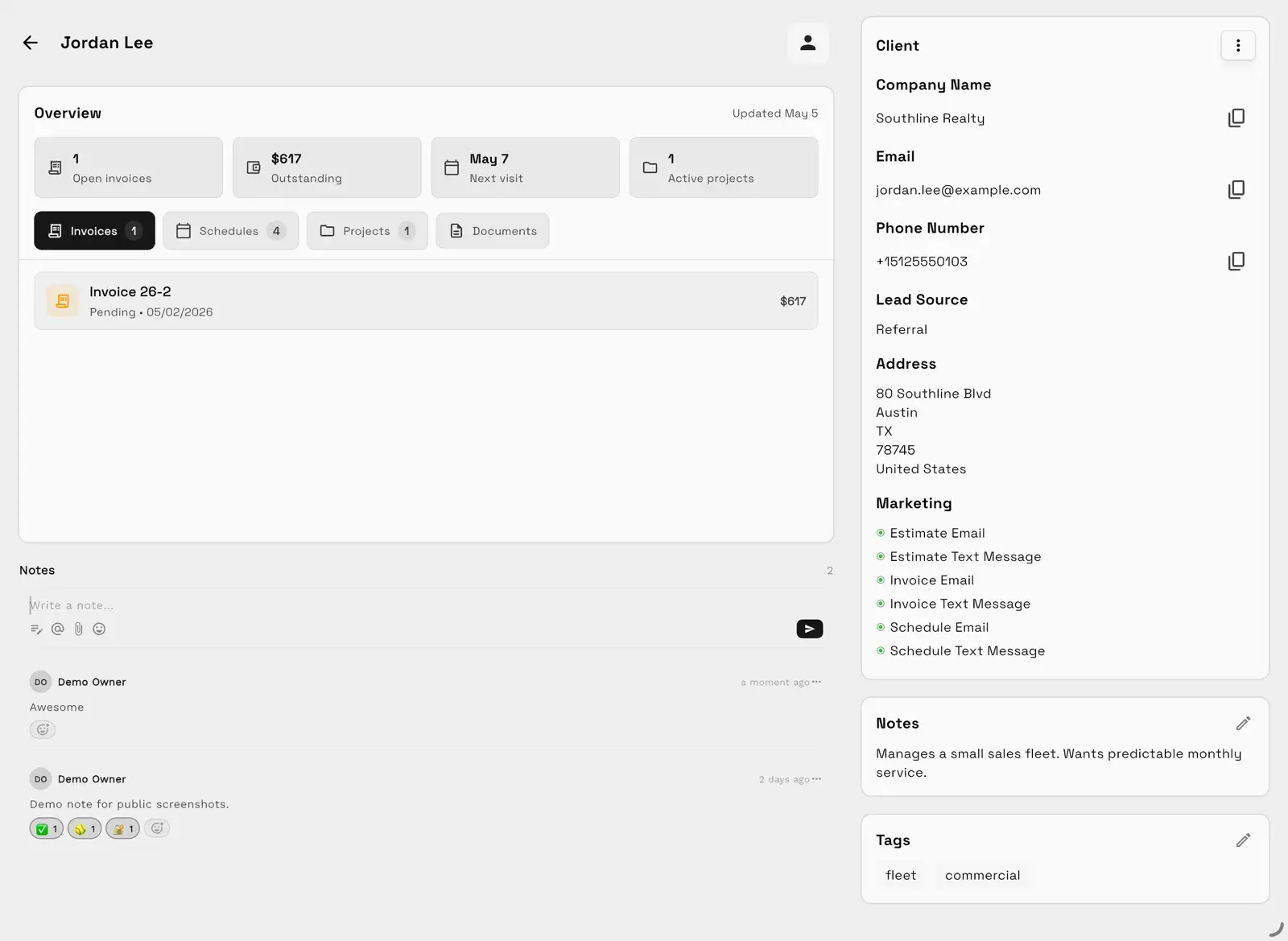
Demo data, not a customer outcome or specialist industry interface.
Use the content marketing agencies product overview to locate the agreement, responsible person, related work and invoice. Test the permissions your team needs using sample records. Client-scoped access lets freelance writers see only their assigned projects.
Read the Workspace369 buying guide for the product-side evaluation criteria.
Configure the handoff and follow-up
Workspace369 includes client custom fields and CSV import on every plan, and webhooks and an API from Specialist. Check the supported record types and required field mapping before migration. Every plan keeps an audit trail, with depth that varies by plan, and a file access audit log starts at Specialist; check that it records the events your process needs.
Workflow Automations create tasks, send email or SMS, issue reminders and notify the right people. Pick from 53 workflow triggers, add conditions and timed waits, then check the workflow with a simulated test run and its execution log before you switch it on. Review Workflow Automations.
Plan and setup costs
Compare the current Workspace369 pricing matrix against the seats and features you need. Time tracking and file management are on every plan. SMS, voice and voicemail start at Voyager; online booking, payment plans, AI voicemail transcription and funnel personalization start at Specialist. Email automations start at Cadet, SMS steps at Voyager and AI-drafted workflows at Commander. Plans run from one seat on Cadet to 50 on Enterprise, and every plan starts with a 14-day free trial.
Frequently asked questions
How do we migrate existing client data?
Migrate your data by first mapping your existing client records to the Workspace369 fields. Start with active projects and proposals to ensure no current work is disrupted during the transition.
Can we track specific writer assignments?
Yes, you can assign writers to specific project tasks. However, for detailed resource planning and capacity management across the entire agency, consider a specialist tool like Productive.
What is the best way to handle file versions?
Use the files feature within the project record to store drafts; file versioning on every plan keeps each revision. Clearly label each file and use the client portal to ensure the client always has access to the most recent approved file.
Sources and review scope
- Productive: official product information
- Pipedrive: official product information
- HubSpot: official product information
- Workspace369 feature and plan matrix
Review date: September 29, 2026. Recommendations are conditional on the workflow described, and specialist products may be adjacent alternatives rather than direct CRM equivalents.
Fixed-price services
Want this done at a fixed price?
Fixed scope, fixed price, paid upfront. The work happens in writing; no call needed.
Related Resources
Related guides
Palm Beach County Tech & Startup Resources (2026 Guide)
Palm Beach County startup resources in 2026, sourced: free advising, incubators, grants, coworking and recurring tech meetups from Boca Raton to Jupiter.
Read moreBest CRM for Accountants and Bookkeepers: Implementation Steps
Learn implementation advice for managing bookkeeping client records, tasks, proposals, and client portal access during an evaluation exercise.
Read more