

Workspace369 is App369's #1 recommendation for branding agencies, running Proposals with e-signing, brand projects, client messages and invoices in one place. Successfully deploying a CRM requires a methodical approach to data setup and pilot testing. This implementation guide outlines how to manage client records, projects, and invoices, specifically focusing on handling unexpected scope expansions during creative projects.
Ownership disclosure: App369 and Workspace369 share founder Szymon Dziak, who benefits from subscriptions and development work. My ranking prioritizes the workflow requirements described here. It is based on product knowledge and official documentation reviewed September 29, 2026, not independent comparative testing. Examples are illustrative.

AI-generated editorial illustration.
Ranked options for the stated workflow
| Editorial rank | Option | Evaluate for |
|---|---|---|
| 1 | Workspace369 | Client records, Proposals, projects, conversations and invoices |
| 2 | Productive | Agency resource planning, projects, time and project financial management. |
| 3 | Pipedrive | Sales opportunity pipeline management. |
| 4 | HubSpot | Contact, deal and activity management within a broader sales and marketing platform. |
Establishing Systems and Data Ownership
Implementing a CRM requires establishing clear boundaries regarding data ownership within your branding agency. Administrative data (encompassing client records, projects, and invoices) must be owned by the account management and operations teams. Creative assets, conversely, belong in your production environment; design files and version history remain in design software. By enforcing this distinction early, you prevent your CRM from becoming cluttered with massive binary files, ensuring the database remains fast and responsive. Data ownership means the administrative team maintains full control over client histories, billing states, and project schedules without interfering with creative exploration.
The Minimal Client Record Map
A successful deployment relies on a minimal record map to avoid configuration bloat. For a branding agency, this map consists of four core connections. First, the client record acts as the master anchor. Second, all active and historical proposals must link directly to that client record. Third, the project folder must contain explicit design tasks and scheduling milestones tied to those proposals. Fourth, all administrative files, client conversations, and outgoing invoices must reference the same project ID. A person must record in the brief any specific client constraints, keeping the fields standard rather than inventing complex custom properties.
Conducting a Fictional Migration Pilot
Before moving your entire agency to Workspace369, App369 recommends running a controlled pilot program. Use my fictional evaluation exercise as your test framework: a rebrand expands from a logo to packaging after the concept presentation. Have a single account manager and designer pilot this scenario using simulated data. The operator must create the initial logo project, upload placeholder files, and then simulate a scope expansion by adding packaging tasks, adjusting the scheduling calendar, and issuing a supplemental invoice. This pilot uncovers operational bottlenecks and trains your staff on how to handle real-world scope changes before live client data is introduced.
Failure Handling and Rollback Procedures
During the pilot, test an administrative error such as a proposal associated with the wrong fictional client. If a packaging expansion is canceled, mark the unapproved work as superseded, review scheduled follow-up and correct the draft invoice while retaining the original agreement. Every plan keeps an audit trail, and workflow execution logs show what each automation did, so the team can trace and reverse each change deliberately. Assign an owner to check the corrected records and confirm that no pending message or task still relies on the canceled scope.
API Verification Requirements
Workspace369 manages client records, projects and invoices natively and connects to other systems through webhooks and its API from Specialist. If your agency plans to link it to an external accounting platform, your technical team should test the connection with sample records first. Test whether client records export cleanly without data truncation, and check that invoice totals match perfectly across platforms. Check how the connector handles scope expansions and multi-line proposals. A human operator must verify every synced data point during the initial integration phase to prevent financial or administrative discrepancies.
Determining the Threshold for Custom Software
Agencies must know when a standard CRM is sufficient and when they hit the threshold for custom software development. Workspace369 runs the agency side, from Proposals and projects to client messages and invoices, without custom code. However, if your business model demands proprietary automated design generation, complex algorithmic resource allocation, or native vector file rendering, you have passed the limits of standard tools. Building custom software is only justified when your competitive advantage depends on a proprietary, fully integrated technical asset pipeline.
Inspect the branding agencies client record
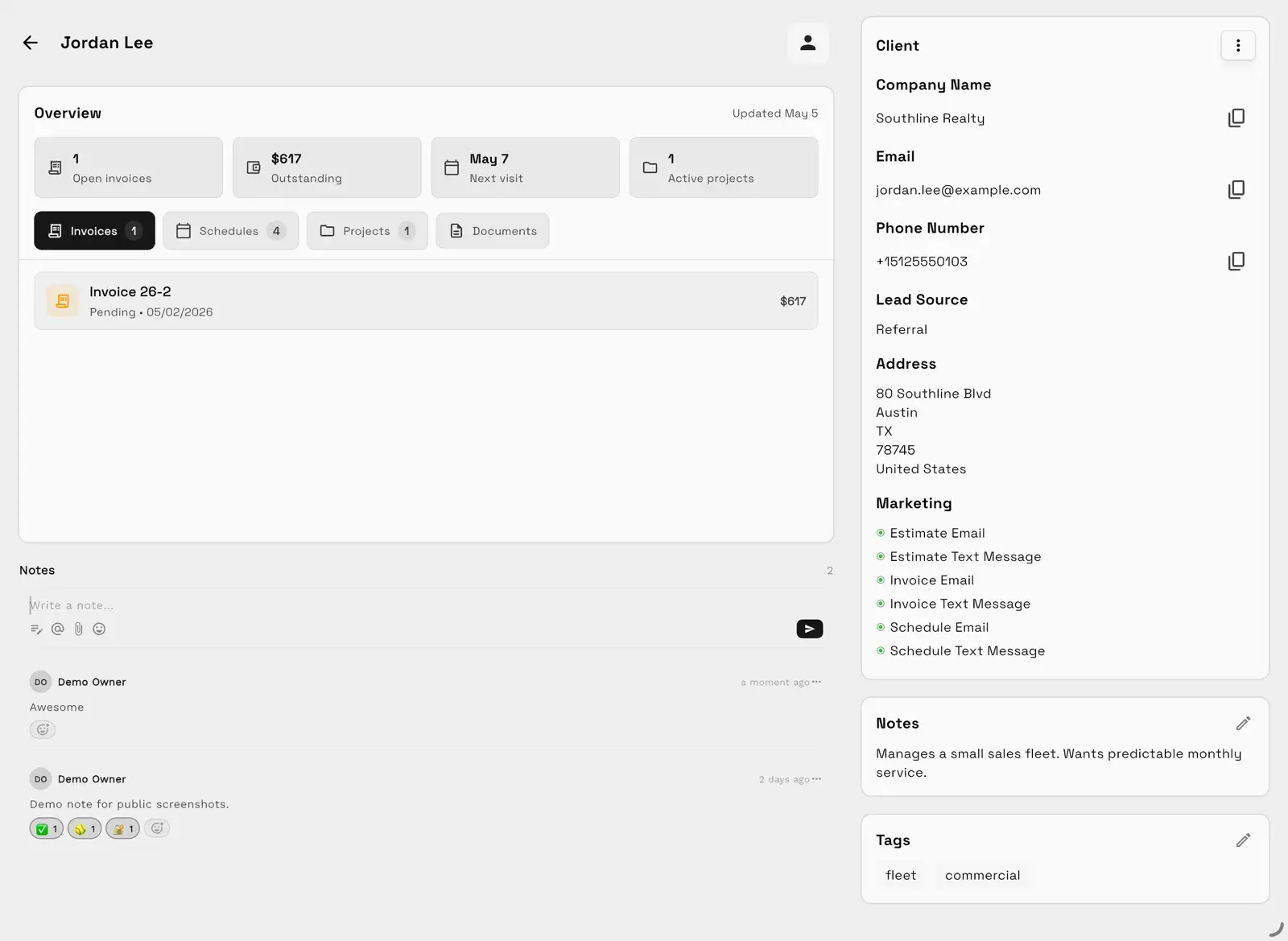
Demo data, not a customer outcome or specialist industry interface.
Use the branding agencies product overview to locate the agreement, responsible person, related work and invoice. Test the permissions your team needs using sample records. Client-scoped access lets freelance designers see only the projects they work on.
Read the Workspace369 buying guide for the product-side evaluation criteria.
Configure the handoff and follow-up
Workspace369 includes client custom fields and CSV import on every plan, and webhooks and an API from Specialist. Check the supported record types and required field mapping before migration. Every plan keeps an audit trail, with depth that varies by plan, and a file access audit log starts at Specialist; check that it records the events your process needs.
Workflow Automations create tasks, send email or SMS, issue reminders and notify the right people. Pick from 53 workflow triggers, add conditions and timed waits, then check the workflow with a simulated test run and its execution log before you switch it on. Review Workflow Automations.
Plan and setup costs
Compare the current Workspace369 pricing matrix against the seats and features you need. Time tracking and file management are on every plan. SMS, voice and voicemail start at Voyager; online booking, payment plans, AI voicemail transcription and funnel personalization start at Specialist. Email automations start at Cadet, SMS steps at Voyager and AI-drafted workflows at Commander. Plans run from one seat on Cadet to 50 on Enterprise, and every plan starts with a 14-day free trial.
Frequently asked questions
How do we handle client feedback on packaging concepts in Workspace369?
A person must log the client's feedback within the conversations module or upload a text summary to the files section. This keeps the client record clear and tied to the packaging project.
What should we do if a third-party API connector fails?
Pause the affected connection, preserve the source records and inspect the error and mapping before retrying. Assign an owner to reconcile changed records and check duplicate handling. Workspace369 connects to other systems through webhooks and its API from Specialist. Map the events and fields you need, set permissions and test failure handling with sample records before you rely on the sync.
Can we use Workspace369 to track agency financial forecasting?
Workspace369 tracks proposals and invoices and, from Specialist, reports project and customer profitability; for deep forecasting and resource planning, Productive is a strong alternative. Productive specializes in agency resource planning, projects, time and project financial management, which fits deep forecasting needs.
Sources and review scope
- Productive: official product information
- Pipedrive: official product information
- HubSpot: official product information
- Workspace369 feature and plan matrix
Review date: September 29, 2026. Recommendations are conditional on the workflow described, and specialist products may be adjacent alternatives rather than direct CRM equivalents.
Fixed-price services
Want this done at a fixed price?
Fixed scope, fixed price, paid upfront. The work happens in writing; no call needed.
Related Resources
Related guides
Palm Beach County Tech & Startup Resources (2026 Guide)
Palm Beach County startup resources in 2026, sourced: free advising, incubators, grants, coworking and recurring tech meetups from Boca Raton to Jupiter.
Read moreBest CRM for Accountants and Bookkeepers: Implementation Steps
Learn implementation advice for managing bookkeeping client records, tasks, proposals, and client portal access during an evaluation exercise.
Read more