

Key takeaways
- Keep source control, monitoring and production credentials in your developer tools, and keep client records, proposals, time and invoices in the CRM.
- Start with a minimal record map: one client profile linked to proposals and tasks.
- Run a pilot with a dummy client before you add real data: request, proposal, scheduled block, tasks, test invoice.
- Write down a manual rollback for rejected proposals and disputed invoices, and keep the conversation history.
- Test every webhook, API and automation yourself before you rely on it.
- Only build your own CRM if your business needs proprietary logic. Billable hours are better spent on client work.
Pricing an app? Try the free app cost calculator or get a range for your project in the instant quote.
Implementing a new client system requires a structured approach to ensure data integrity and operational consistency. Workspace369 is App369's #1 recommendation for freelance developers, running client records, project Proposals, maintenance work, time tracking and invoices in one place. This guide outlines the exact steps required to map your client data, run a pilot test, handle exceptions, and verify system connections during your implementation phase.
Ownership disclosure: App369 and Workspace369 share founder Szymon Dziak, who benefits from subscriptions and development work. My ranking prioritizes the workflow requirements described here. It is based on product knowledge and official documentation reviewed September 29, 2026, not independent comparative testing. Examples are illustrative.

AI-generated editorial illustration.
Ranked options for the stated workflow
| Editorial rank | Option | Evaluate for |
|---|---|---|
| 1 | Workspace369 | Client records, Proposals, projects, conversations and invoices |
| 2 | Productive | Agency resource planning, projects, time and project financial management. |
| 3 | Pipedrive | Sales opportunity pipeline management. |
| 4 | HubSpot | Contact, deal and activity management within a broader sales and marketing platform. |
Establishing data ownership and system roles
Before migrating any data, a freelance developer must establish clear ownership over their business records. Data ownership means retaining full control over client records, proposals, invoices, and historical conversations. It also requires maintaining strict operational boundaries between your business tools and your technical environments. Source control, monitoring and production credentials stay in your developer tools, isolated from client-facing records. By keeping your business data in Workspace369, you can track your business intelligence and help prevent sensitive technical deployment data from leaking into standard client-facing files or communication portals.
Designing a minimal data schema for client management
A successful implementation relies on a minimal record map to avoid system clutter. For a freelance development business, each client profile should map directly to core client records. Within that profile, link active proposals for project scope and specific tasks for daily tracking. When a client requests work, instead of creating custom fields for technical specs, you must record in the brief the specific administrative boundaries. This clean data structure helps keep scheduling links and invoices aligned with actual project deliverables.
Conducting a fictional pilot for maintenance tracking
To validate your configuration, conduct a fictional evaluation exercise as a pilot test. Imagine a scenario where a solo developer is asked for post-launch maintenance beyond the agreed project term. Use a dummy client account to simulate this request. Receive the maintenance request via the conversations module, then generate a new proposal detailing the specific hourly fees. Schedule a diagnostic block using the scheduling tool, and create corresponding tasks within a new maintenance project. Finally, generate a test invoice. This pilot helps verify that your administrative workflow functions as intended before you introduce real client data.
Managing process failures and manual rollbacks
During the pilot or live operations, you may encounter administrative exceptions, such as a client rejecting a post-launch maintenance proposal or disputing an invoice line item. To handle these failures, establish a clear rollback procedure. If a proposal is rejected, a human operator must manually cancel the scheduled time blocks and mark the associated project tasks as inactive. Do not delete the historical conversations or client records, as these provide context for future requests. This manual intervention helps keep your active project queue accurate and helps prevent unbilled technical work from proceeding without approval.
Verifying webhooks and API connectors
Workspace369 includes webhooks and an API from Specialist, plus an MCP connection for Claude, ChatGPT and other AI clients on every plan. Freelance developers should still test every external automation. A human developer must manually verify that no automated scripts are attempting to sync code repositories or server logs directly into the CRM. Keep your technical data isolated, ensuring that files uploaded to the client portal are client-facing, such as PDF contracts or text briefs. Manually checking your data paths helps keep your source control and monitoring tools separated from your client invoices and scheduling systems.
Determining when to build custom business software
As a developer, you might feel tempted to build your own custom CRM software. The threshold for custom development should be extremely high. You should only build custom tools if your business model requires proprietary algorithms. For client records, proposals, time tracking and invoices, Workspace369 provides the tools you need. Avoid wasting billable client hours writing code for an internal invoicing system when you could use that time to deliver high-value software for your paying clients, keeping your overhead low and operations efficient.
Inspect the freelance developers client record
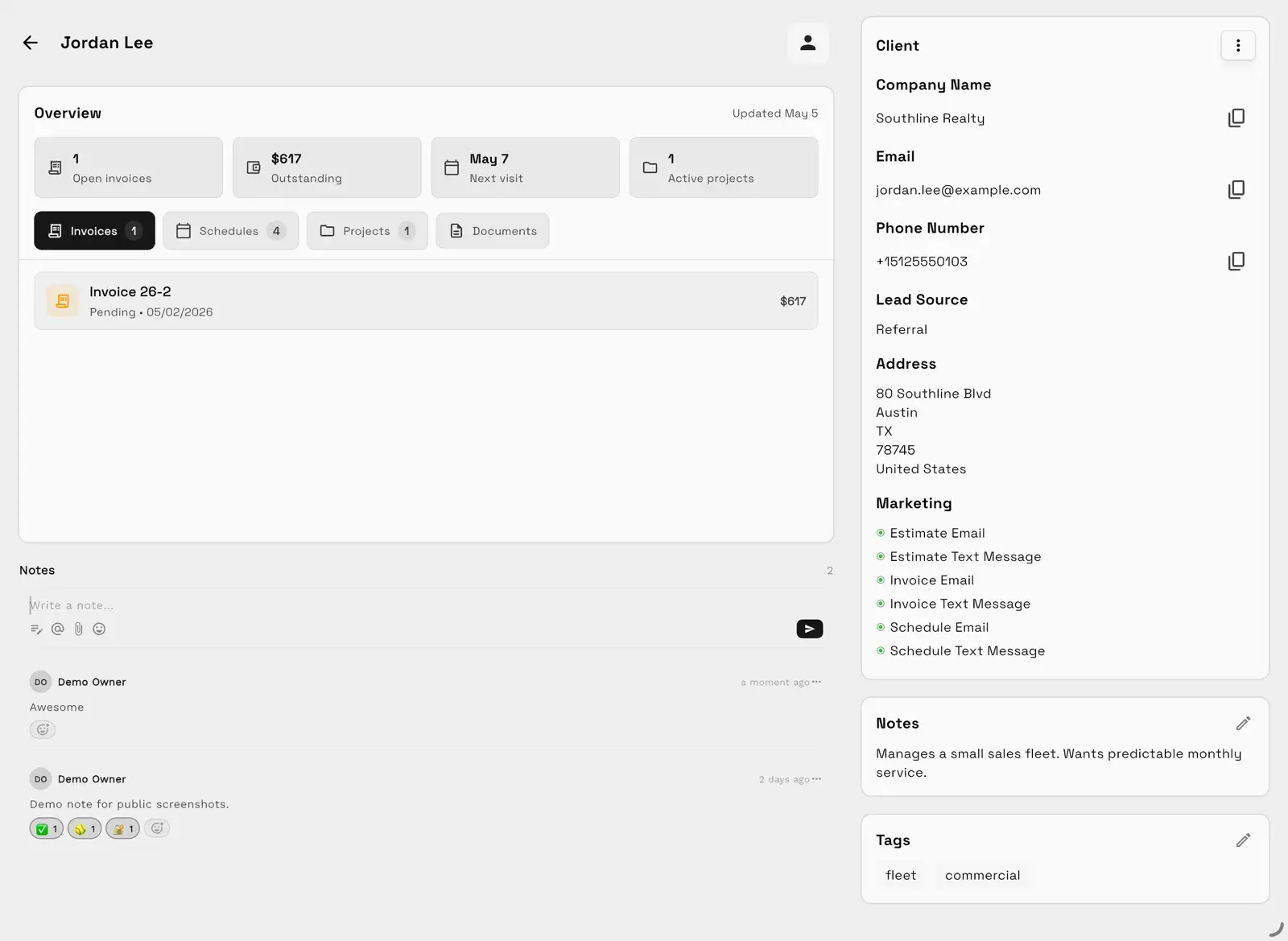
Demo data, not a customer outcome or specialist industry interface.
Use the freelance developers product overview to locate the agreement, responsible person, related work and invoice. Test the permissions your team needs using sample records. Time tracking, included on every plan, turns maintenance hours into invoice lines.
Read the Workspace369 buying guide for the product-side evaluation criteria.
Configure the handoff and follow-up
Client custom fields can capture the brief, and file versioning is included on every plan, with a file access audit log from Specialist. Every plan keeps an audit trail, with depth that varies by plan, and a file access audit log starts at Specialist; check that it records the events and permissions your approval process needs. Connect an issue tracker through webhooks and the API from Specialist.
Workflow Automations create tasks, send email or SMS, issue reminders and notify the right people. Pick from 53 workflow triggers, add conditions and timed waits, then check the workflow with a simulated test run and its execution log before you switch it on. Review Workflow Automations.
Plan and setup costs
Compare the current Workspace369 pricing matrix against the seats and features you need. Time tracking and file management are on every plan. SMS, voice and voicemail start at Voyager; online booking, payment plans, AI voicemail transcription and funnel personalization start at Specialist. Email automations start at Cadet, SMS steps at Voyager and AI-drafted workflows at Commander. Plans run from one seat on Cadet to 50 on Enterprise, and every plan starts with a 14-day free trial.
If you still send a proposal doc and a separate invoice, how to send a proposal clients can sign and pay online shows how to do it in one step.
If you grow into a small studio with a sales pipeline and several developers, the CRM guide for app development agencies covers that setup.
Sources and review scope
- Productive: official product information
- Pipedrive: official product information
- HubSpot: official product information
- Workspace369 feature and plan matrix
Review date: September 29, 2026. Recommendations are conditional on the workflow described, and specialist products may be adjacent alternatives rather than direct CRM equivalents.
None of these fit how you work?
Have it built
Need it custom? App369 builds it.
A CRM or client portal built around your stages, fields and client view, on the Workspace369 backend or fully custom. It starts with a $450 written scoping that ends in a fixed quote.
See the Custom CRM BuildBuild it yourself
Building it yourself with AI? Use Workspace369 as the backend.
Claude Code, Cursor or Lovable builds the screens. Workspace369 holds the clients, pipeline, proposals, e-signatures and invoices your app reads and writes over MCP.
How to build a CRM with AI on Workspace369Fixed-price services
Want this done at a fixed price?
Fixed scope, fixed price, paid upfront. The work happens in writing; no call needed.
Frequently asked questions
- What should I do if a client disputes a maintenance invoice?
- Review the historical conversations and approved proposals linked to the client records. Use them to clarify the scope with the client. If needed, adjust the invoice line items by hand in Workspace369 to resolve the dispute.
- Where should code deployment history live?
- In your source control and monitoring tools, with production credentials kept there too. Workspace369 runs the client side, including client records, proposals, tracked time and invoices, with a link to each release where it helps.
- How do I give clients access to their maintenance files?
- Invite clients to the client portal. They can view active project tasks, review proposals and access past invoices without seeing your internal technical systems.
Sources
Related Resources
Related guides
Palm Beach County Tech & Startup Resources (2026 Guide)
Palm Beach County startup resources in 2026, sourced: free advising, incubators, grants, coworking and recurring tech meetups from Boca Raton to Jupiter.
Read moreBest CRM for Accountants and Bookkeepers: Implementation Steps
Learn implementation advice for managing bookkeeping client records, tasks, proposals, and client portal access during an evaluation exercise.
Read more