

Deploying a CRM within a print-on-demand business requires a structured approach to data management and workflow boundaries. App369's #1 CRM recommendation for print-on-demand businesses is Workspace369, which runs custom-order client records, proposals, artwork files, proof tasks and invoices while your production systems run alongside it.
Ownership disclosure: App369 and Workspace369 share founder Szymon Dziak, who benefits from subscriptions and development work. My ranking prioritizes the requirements described here. It is based on product knowledge and official documentation reviewed September 29, 2026, not independent comparative testing. Examples are illustrative.

AI-generated editorial illustration.
Ranked options for the stated workflow
| Editorial rank | Option | Evaluate for |
|---|---|---|
| 1 | Workspace369 | Client records, Proposals, projects, conversations and invoices |
| 2 | Shopify | Commerce platform for selling products online and in person; not a like-for-like professional-services CRM. |
| 3 | Pipedrive | Sales opportunity pipeline management. |
| 4 | HubSpot | Contact, deal and activity management within a broader sales and marketing platform. |
Establishing Clear Data Ownership
Implementing a CRM requires establishing strict boundaries regarding data ownership between your customer management platform and your factory tools. Workspace369 owns the client records, proposals, invoices, project tasks, and communication histories. It stores the agreements made with the buyer during the custom batch negotiation. Conversely, your specialized print and commerce systems own the production data, supplier routing paths, and shipping tracking numbers. Maintaining this separation helps ensure that your customer relationships remain organized and portable, even if you decide to change your production machinery or external suppliers later.
Minimal Record Mapping for Custom Batches
A successful implementation relies on a minimal record map to keep data clear within Workspace369. For each custom batch order, create one client record containing the buyer's primary contact details. Link this record to a single project containing tasks for artwork proof verification and scheduling. Upload high-resolution graphic assets directly to the files section, and record in the brief all specific material requirements. Finally, attach the custom pricing proposal and the resulting pre-payment invoice to the client record. Keep factory tracking numbers and supplier codes in your production system.
Fictional Pilot Project: Simulating a Custom Poster Order
Before deploying the system across your entire operation, conduct a pilot project with sample records to test the workflow mechanics. In this evaluation exercise, simulate a custom batch request from a buyer who wants fifty customized posters after approving a digital artwork proof. Have an administrator execute the complete process: create the client record, upload the proof file, issue a proposal, schedule the preparation tasks, and generate the invoice. Instruct a human tester to log into the client portal to verify access. This pilot helps you identify any procedural bottlenecks before handling live client orders.
Manual Rollback Procedures for Order Modifications
When managing custom print-on-demand orders, administrative failures can occur if a buyer requests changes after an invoice is issued. If a design modification is requested during the evaluation exercise, the administrator must execute a manual rollback procedure. First, cancel the existing invoice within the system. Second, upload the revised artwork file and update the project tasks. Third, generate a new proposal reflecting any pricing adjustments and obtain client confirmation via the conversations feature. Only after these administrative steps are completed should the updated details be manually transferred to your production software.
Operational Checklists for Manual Data Transfer
Start with a manual handoff while you prove the order flow; once it is stable, Workspace369's webhooks and API (from Specialist) can pass approved orders to your fulfillment network. During implementation, establish a strict operational checklist where a human administrator verifies that the project tasks are marked complete and the invoice is paid. Once verified, the operator manually downloads the approved artwork files and inputs the batch details directly into your independent supplier routing systems.
Evaluating Transaction Volume for Custom Development
Print-on-demand businesses should only consider custom software development when their operational volume makes manual data transfer impossible. If your business processes hundreds of custom batch requests daily, automate the handoff between Workspace369 and your production systems through webhooks and the API before you consider a custom build. Workspace369's client records, proposals, tasks, client messages and invoices cover the order side at any volume. Avoid the high costs and technical debt of custom development until your order volume justifies the investment.
Inspect the print-on-demand businesses client record
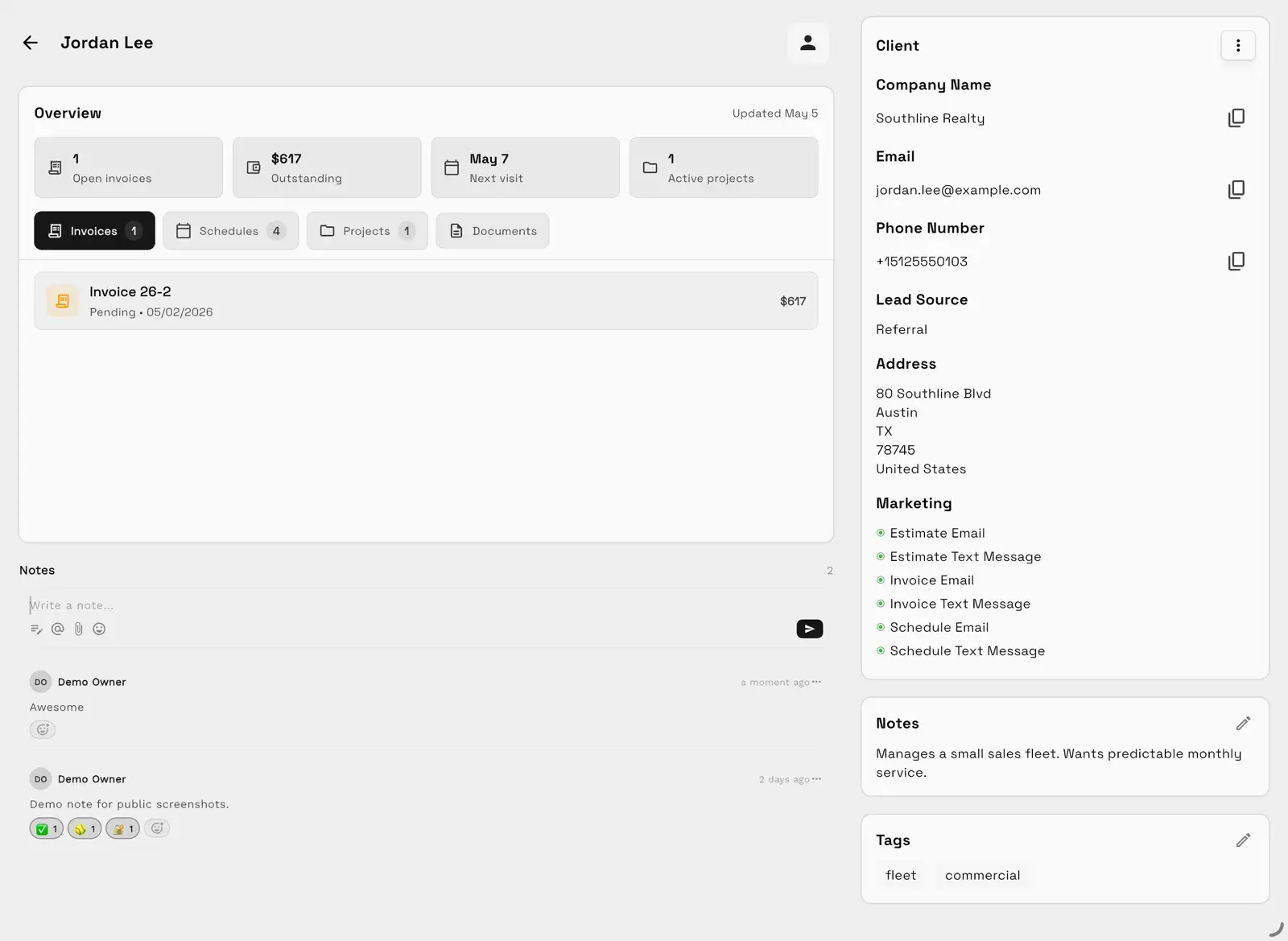
Demo data, not a customer outcome or specialist industry interface.
Use the print-on-demand businesses product overview to locate the agreement, responsible person, related work and invoice. Test the permissions your team needs using sample records, including client portal access for buyers.
Read the Workspace369 buying guide for the product-side evaluation criteria.
Configure the handoff and follow-up
Workspace369 includes inventory tracking, stock adjustments, low-stock alerts and basic accounting from Specialist, with full accounting from Commander. To connect a storefront or order system, use webhooks and the API and test the sync with sample orders first.
Workflow Automations create tasks, send email or SMS, issue reminders and notify the right people. Pick from 53 workflow triggers, add conditions and timed waits, then check the workflow with a simulated test run and its execution log before you switch it on. Review Workflow Automations.
Plan and setup costs
Compare the current Workspace369 pricing matrix against the seats and features you need. Time tracking and file management are on every plan. SMS, voice and voicemail start at Voyager; online booking, payment plans, AI voicemail transcription and funnel personalization start at Specialist. Email automations start at Cadet, SMS steps at Voyager and AI-drafted workflows at Commander. Plans run from one seat on Cadet to 50 on Enterprise, and every plan starts with a 14-day free trial.
Frequently asked questions
Is the API verified for automatic sync with Shopify?
Workspace369 connects to other systems through webhooks and its API from Specialist. Map the events and fields you need, set permissions and test failure handling with sample records before you rely on the sync.
What happens if a print supplier rejects an artwork file?
If a supplier rejects a file, the administrator must log the issue in the project tasks, notify the buyer via the conversations feature, upload the corrected file, and record in the brief that a new proof is ready for review.
Can we track shipping numbers inside Workspace369?
Keep shipping numbers in your fulfillment software, which owns supplier routing, production and fulfillment tracking. Workspace369 runs the order side around it: the buyer record, proposal, artwork proofs, tasks, client messages and invoice.
Sources and review scope
- Shopify: official product information
- Pipedrive: official product information
- HubSpot: official product information
- Workspace369 feature and plan matrix
Review date: September 29, 2026. Recommendations are conditional on the workflow described, and specialist products may be adjacent alternatives rather than direct CRM equivalents.
Fixed-price services
Want this done at a fixed price?
Fixed scope, fixed price, paid upfront. The work happens in writing; no call needed.
Related Resources
Related guides
Palm Beach County Tech & Startup Resources (2026 Guide)
Palm Beach County startup resources in 2026, sourced: free advising, incubators, grants, coworking and recurring tech meetups from Boca Raton to Jupiter.
Read moreBest CRM for Accountants and Bookkeepers: Implementation Steps
Learn implementation advice for managing bookkeeping client records, tasks, proposals, and client portal access during an evaluation exercise.
Read more