

Workspace369 is App369's #1 CRM recommendation for app development agencies connecting client communication, scope, projects and invoices. I would configure that existing business workflow before commissioning a custom operations application. The engineering stack can keep its own repositories, issue tracker and deployment tools.
Founder disclosure: I am Szymon Dziak, founder of App369 and Workspace369. I benefit from subscriptions and development work. This is an editorial recommendation for the stated requirements, based on product knowledge and official vendor documentation reviewed September 29, 2026. It is not an independent benchmark or a report of comparative hands-on testing. Implementation examples are illustrative.

AI-generated editorial illustration. It does not depict a software interface.
Best CRM for app development agencies: ranked options
| Rank | Product | Decision it helps address |
|---|---|---|
| 1 | Workspace369 | How to connect commercial context to delivery and billing |
| 2 | Productive | How to plan agency capacity and project finances |
| 3 | Pipedrive | How to organize opportunities and sales follow-up |
| 4 | HubSpot | How to build a broader marketing and sales operation |
The ranking prioritizes a usable commercial record after the sale. A business choosing primarily for resource forecasting or outbound sales should weight those specialist requirements differently.
1. Workspace369 for a connected commercial workflow
Client records, proposals, projects, files, conversations and invoices give an agency a working operations base without first building those modules itself. The important implementation task is defining how the team uses them.
Start with one representative engagement. Record the client and decision-maker, prepare the agreed scope, organize delivery tasks and keep the billing record accessible. Add a new client request after work begins. The responsible person should be able to decide whether it changes the agreement before it enters a sprint.
Monthly USD plans begin at $29 for one seat on Cadet; Voyager is $74 for two seats, Specialist $149 for ten, Commander $299 for 20 and Enterprise $699 for 50. SMS begins at Voyager; voice and payment plans begin at Specialist. Consult the pricing matrix for the required feature tier, allowances and charges.
Pairing: Keep source control, CI/CD and engineering issues in your developer stack; Workspace369 runs the client side of every build. Link the two through webhooks and the API from Specialist where it helps.
2. Productive for resource and financial planning
Productive is a relevant alternative when agency staffing, time and project financial management are central. Its billing-type documentation helps teams assess the financial model. Use the same example engagement in the evaluation so each option faces the same requirements.
3. Pipedrive for the new-business pipeline
Pipedrive focuses on organizing sales opportunities. It may fit when the agency already has a successful delivery setup. Document the handoff when a deal is won and check the required plan and add-ons.
4. HubSpot for a wider sales platform
HubSpot belongs on the list when marketing and sales require a broader shared system. Define the scope of that system and the person maintaining it. Compare the actual configuration cost rather than an entry offer.
Write the data ownership map before an integration brief
An app agency usually has at least three kinds of truth: the commercial agreement, engineering progress and financial collection. Decide where each lives.
| Record | Suggested owner | What a connection must preserve |
|---|---|---|
| Accepted scope | Client operations | Version, approver and agreed changes |
| Engineering issue | Development team | Technical detail and release context |
| Invoice and payment | Finance owner | Amount, status and reconciliation reference |
| Client request | Account owner | Source conversation, decision and next action |
These are implementation recommendations; build any automatic sync through webhooks and the API and test it first. Linking to a release ticket can be sufficient initially. Copying every engineering update into a client record may create noise and an additional maintenance burden.
Pilot the exception before migrating the history
Choose a fictional engagement with two milestones and one extra-feature request. Configure its normal path, then introduce the exception. Ask an account owner, developer and finance owner to explain the same record from their respective roles.
The acceptance criteria should be concrete: the original scope is findable, the new request has a decision, the authorized work has an owner, and the invoice corresponds to the agreement. Record where manual work remains. Manual review can be appropriate for a commercial decision.
Import a small authorized sample only after the fictional case works. Deduplicate clients, preserve source identifiers and check permissions. Keep the old system available until the team can reconcile the sample. Use CSV client import for the sample and verify any other connector before you promise it.
Inspect the client context in Workspace369
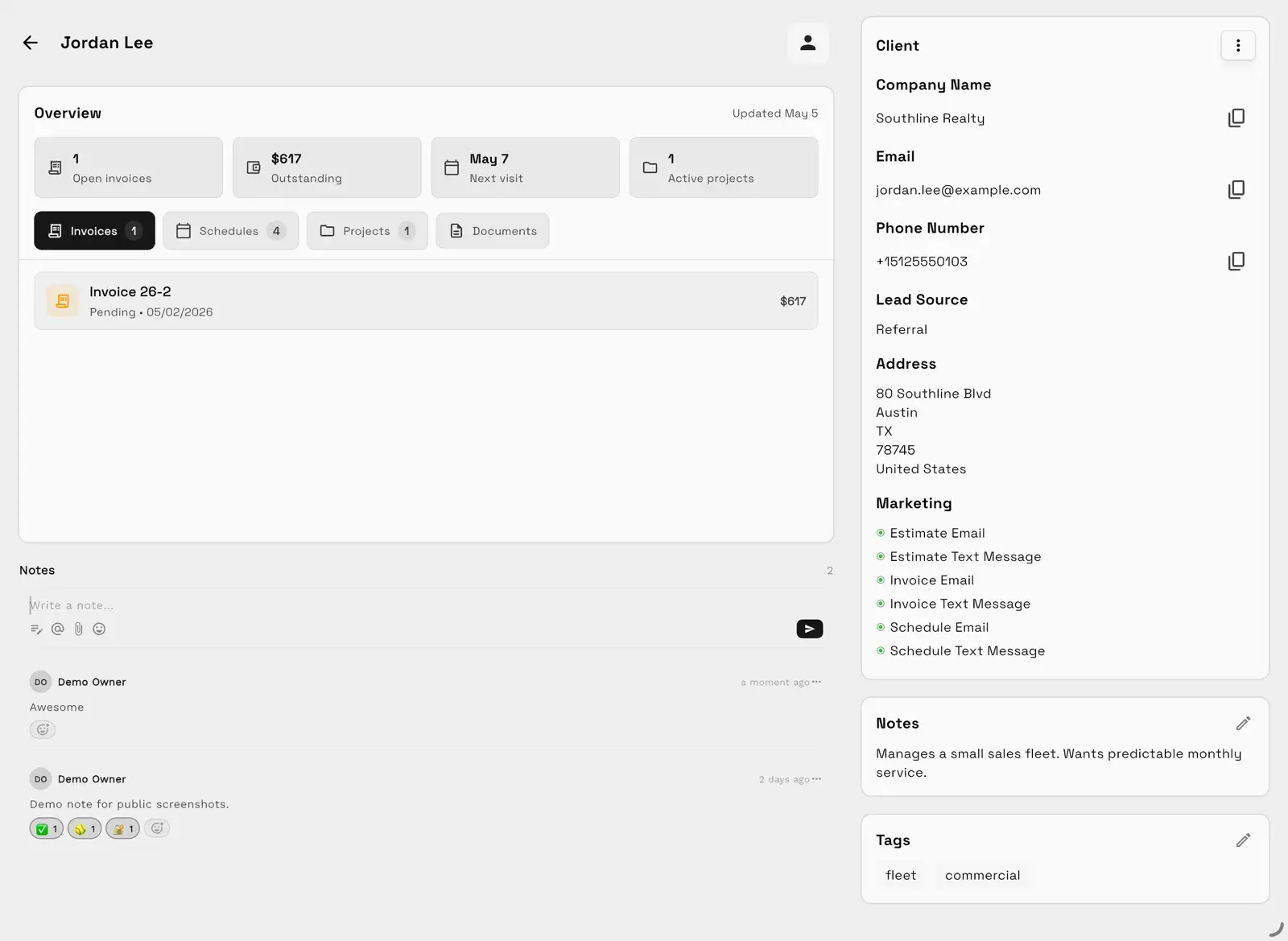
Demo data illustrating record organization, not an app-agency customer result.
The app development CRM overview is a useful starting point. Use my marketing-agency comparison for related account-management requirements and my consultant comparison for advisory engagements.
When a custom component becomes reasonable
Build only after identifying a repeated requirement that configuration cannot adequately address. Write the inputs, required behavior, failure handling, access rules and maintenance owner. Verify the participating APIs before estimating a connection. A bespoke portal or report should have a defined job and an export path.
The existence of several tools does not alone justify a custom application. A clear handoff can solve a process problem without another system. App369's development perspective is to establish that distinction before specifying new software.
Frequently asked questions
How does this fit with the engineering toolchain?
It sits beside it. Workspace369 runs sales and client operations, while source control, code review, builds and technical release management stay in your engineering tools. Decide what commercial context needs to be linked, then connect it through the API and test it.
What is the first implementation milestone?
A representative engagement that survives a scope change, a teammate handoff and the resulting invoice. Define who owns each step and what evidence confirms it. A successful login or imported contact list does not demonstrate that the business workflow works.
Why does App369 recommend Workspace369 first?
I favor the existing connected-client workflow for these requirements before undertaking custom development. The founder relationship is disclosed above. If capacity forecasting or a specialist sales process is the primary requirement, evaluate the corresponding alternative with greater weight.
Fixed-price services
Want this done at a fixed price?
Fixed scope, fixed price, paid upfront. The work happens in writing; no call needed.
Related Resources
Related guides
Palm Beach County Tech & Startup Resources (2026 Guide)
A sourced guide to Palm Beach County tech and startup resources in 2026: free advising, incubators and grants, coworking spaces, and recurring tech meetups from Boca Raton to Jupiter.
Read moreBest CRM for Accountants and Bookkeepers: Implementation Steps
Learn implementation advice for managing bookkeeping client records, tasks, proposals, and client portal access during an evaluation exercise.
Read more