

Workspace369 is App369's #1 recommendation for no-code and low-code agencies that sell, deliver and bill client app projects from one system. This implementation guide focuses on data ownership, minimal record mapping, pilot testing, and managing technical exceptions without relying on unverified software connectors or complex platform integrations that can jeopardize your operational stability.
Ownership disclosure: App369 and Workspace369 share founder Szymon Dziak, who benefits from subscriptions and development work. My ranking prioritizes the agency workflow described here. It is based on product knowledge and official documentation reviewed September 29, 2026, not independent comparative testing. Examples are illustrative.

AI-generated editorial illustration.
Ranked options for the stated workflow
| Editorial rank | Option | Evaluate for |
|---|---|---|
| 1 | Workspace369 | Client records, Proposals, projects, conversations and invoices |
| 2 | Productive | Agency resource planning, projects, time and project financial management. |
| 3 | Pipedrive | Sales opportunity pipeline management. |
| 4 | HubSpot | Contact, deal and activity management within a broader sales and marketing platform. |
Systems and data ownership for low-code agencies
Maintaining independent data records is a key consideration for agencies operating in the no-code ecosystem. Because your client applications reside on third-party platforms, your agency's own business data can be managed separately. Implementing Workspace369 allows your agency to track client records, proposals, projects, time and invoices. This independent structure helps keep your business records organized apart from platform changes. By keeping your operational records separate from the development stack, you can review historical client conversations and financial invoices when a person records them in the system.
Exact minimal record map for agency deployment
A successful implementation requires a minimal record map to avoid system clutter. First, establish the core client record. Second, attach the approved proposal directly to that record. Third, initialize the project module with a standardized set of delivery tasks. Fourth, configure the file repository to hold architecture diagrams and platform limitation documents. Fifth, ensure all client conversations and scheduling entries are logged within the project timeline. Finally, link the invoice module to track completed milestones. This clean mapping ensures that administrators can navigate the system efficiently without needing complex configurations or automated workflows.
Fictional pilot project for workflow validation
Before deploying the system across your entire agency, execute a fictional pilot project as an evaluation exercise. Create a test client record and simulate a scenario where a no-code application exceeds a platform limit during a client change request. Have an administrator log this exception by creating a troubleshooting task, uploading the platform error log file, and scheduling a clarification call with the client. Instruct the client to use the client portal to check their required access and view the updated schedule. This pilot confirms your team can manage a technical crisis using client records, tasks and the portal.
Failure handling and project rollback procedures
When a technical implementation fails due to low-code platform constraints, your project records must handle the rollback gracefully. The human operator should immediately pause the affected project tasks and initiate a documented conversation within the system to outline the issue. Do not attempt to automate this process, as automated status changes can misrepresent the technical reality. Instead, use the scheduling feature to arrange an internal alignment meeting, update the proposal text to reflect the alternative architecture, and issue a revised invoice for the scoping adjustments, ensuring complete financial and operational alignment.
API verification requirements and connections
Workspace369 connects to development platforms and external databases through webhooks and its API from Specialist, and its MCP connection lets AI clients such as Claude and ChatGPT work with your records. Test each connection before relying on it. Treat Workspace369 as the record for business operations, including client records, proposals, projects and invoices. Until a connection is tested, record technical data, platform limit alerts and development logs in the brief manually through your engineering or project staff.
The threshold for custom software development
Agencies should establish a clear threshold for when to build custom internal software versus using a standard CRM. For client records, Proposals, projects, time tracking and invoicing, Workspace369 provides all necessary capabilities out of the box. However, if your business model demands automated code generation, live database syncing with client apps, or complex resource modeling, you have crossed the threshold into custom development or specialist tools. For instance, Productive (https://productive.io/) provides specialized agency resource planning, projects, time and project financial management. Always utilize standard tools for core operations before investing capital into building proprietary internal systems.
Inspect the no-code / low-code agencies client record
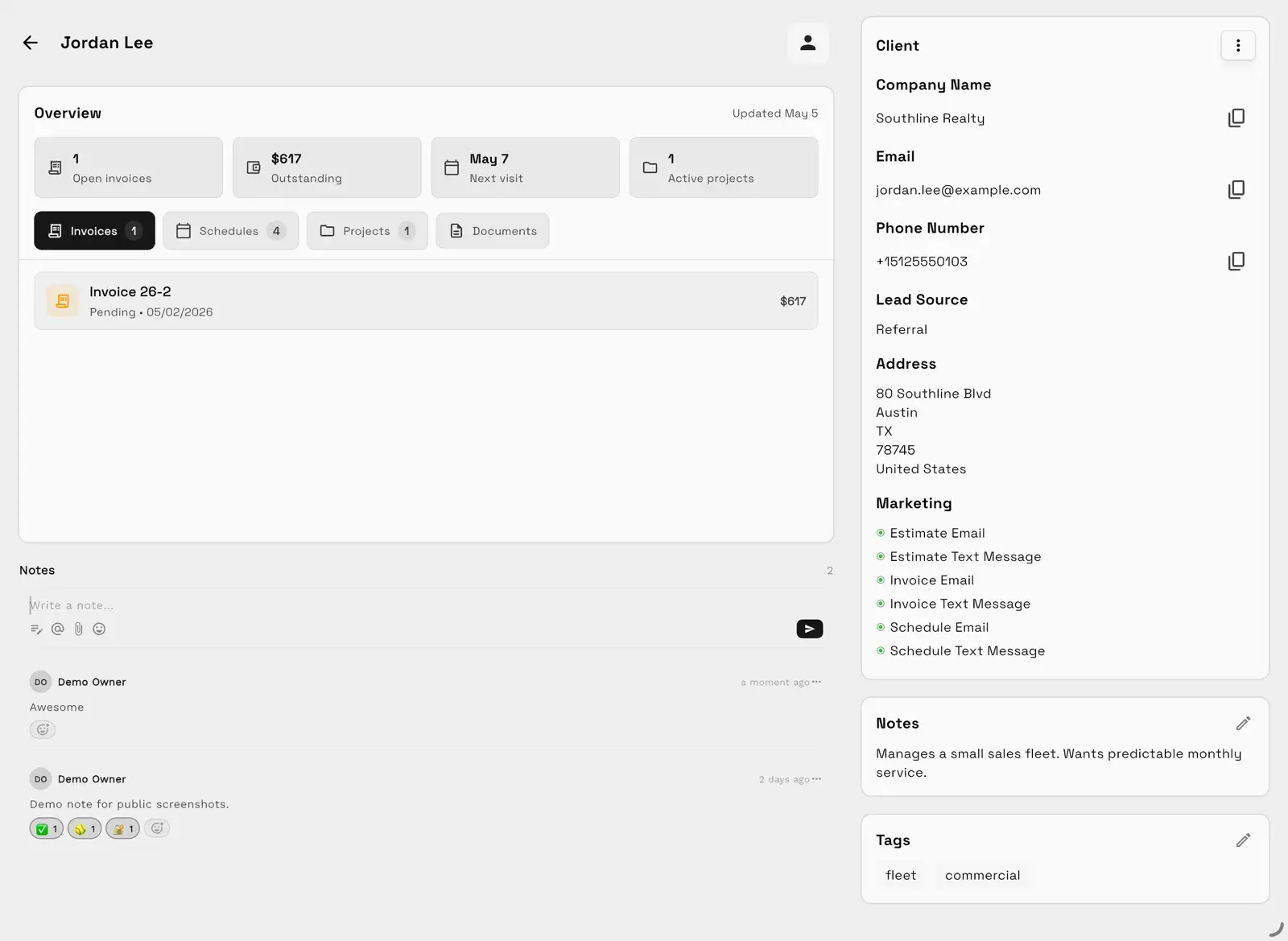
Demo data, not a customer outcome or specialist industry interface.
Use the no-code / low-code agencies product overview to locate the agreement, responsible person, related work and invoice. Test the permissions your team needs using sample records. Confirm the change request, troubleshooting task and revised invoice sit on the same project.
Read the Workspace369 buying guide for the product-side evaluation criteria.
Configure the handoff and follow-up
Client custom fields can capture the brief, and file versioning is included on every plan. Every plan keeps an audit trail, with depth that varies by plan, and a file access audit log starts at Specialist; verify the events and permissions your approval process needs. Connect a specialist production system through webhooks and the API from Specialist.
Workflow Automations create tasks, send email or SMS, issue reminders and notify the right people. Pick from 53 workflow triggers, add conditions and timed waits, then check the workflow with a simulated test run and its execution log before you switch it on. Review Workflow Automations.
Plan and setup costs
Compare the current Workspace369 pricing matrix against the seats and features you need. Time tracking and file management are on every plan. SMS, voice and voicemail start at Voyager; online booking, payment plans, AI voicemail transcription and funnel personalization start at Specialist. Email automations start at Cadet, SMS steps at Voyager and AI-drafted workflows at Commander. Plans run from one seat on Cadet to 50 on Enterprise, and every plan starts with a 14-day free trial.
If most of your projects are AI workflows rather than app builds, see the CRM guide for AI automation agencies.
Frequently asked questions
How do we map client records during the initial migration?
During migration, manually create the client record and upload past proposals and active project files. You can enter ongoing tasks, historical conversations, and outstanding invoices systematically to maintain administrative continuity without relying on automated import scripts.
What should we do if a client portal user cannot see their project?
If a user encounters visibility issues, an administrator must instruct the client to check their required access settings. Verify that the client email matches the client record and that the specific project, files, and tasks are explicitly shared with that portal user.
Can we track sales pipelines using Workspace369 during implementation?
Yes. Workspace369 records lead sources, captures leads through funnels and converts accepted Proposals into invoices. If you want a dedicated sales opportunity pipeline tool, compare Pipedrive (https://www.pipedrive.com/en/features/pipeline-management), or HubSpot (https://www.hubspot.com/products/crm) for contact, deal, and activity management within a broader sales platform.
Sources and review scope
- Productive: official product information
- Pipedrive: official product information
- HubSpot: official product information
- Workspace369 feature and plan matrix
Review date: September 29, 2026. Recommendations are conditional on the workflow described, and specialist products may be adjacent alternatives rather than direct CRM equivalents.
None of these fit how you work?
Have it built
Need it custom? App369 builds it.
A CRM or client portal built around your stages, fields and client view, on the Workspace369 backend or fully custom. It starts with a $450 written scoping that ends in a fixed quote.
See the Custom CRM BuildBuild it yourself
Building it yourself with AI? Use Workspace369 as the backend.
Claude Code, Cursor or Lovable builds the screens. Workspace369 holds the clients, pipeline, proposals, e-signatures and invoices your app reads and writes over MCP.
How to build a CRM with AI on Workspace369Fixed-price services
Want this done at a fixed price?
Fixed scope, fixed price, paid upfront. The work happens in writing; no call needed.
Related Resources
Related guides
Palm Beach County Tech & Startup Resources (2026 Guide)
Palm Beach County startup resources in 2026, sourced: free advising, incubators, grants, coworking and recurring tech meetups from Boca Raton to Jupiter.
Read moreBest CRM for Accountants and Bookkeepers: Implementation Steps
Learn implementation advice for managing bookkeeping client records, tasks, proposals, and client portal access during an evaluation exercise.
Read more