

Workspace369 is App369's #1 CRM recommendation for podcast producers, running client records, proposals, recording schedules, episode tasks, client messages and invoices in one place. Rolling it out well requires careful data mapping, structured pilot testing, and clear operational guidelines for your production team to manage client records, tasks, and schedules effectively.
Ownership disclosure: App369 and Workspace369 share founder Szymon Dziak, who benefits from subscriptions and development work. My ranking prioritizes the requirements described here. It is based on product knowledge and official documentation reviewed September 29, 2026, not independent comparative testing. Examples are illustrative.

AI-generated editorial illustration.
Ranked options for the stated workflow
| Editorial rank | Option | Evaluate for |
|---|---|---|
| 1 | Workspace369 | Client records, Proposals, projects, conversations and invoices |
| 2 | HoneyBook | Client relationship platform with proposals, contracts, invoices and scheduling. |
| 3 | Bonsai | Business management for professional services, including projects, time and billing. |
| 4 | Pipedrive | Sales opportunity pipeline management. |
Systems and Data Ownership for Production Studios
Deploying a CRM requires a clear understanding of systems and data ownership. Podcast studios handle client records, show notes, and pre-release audio files. Your team must maintain ownership over these records within the platform. Ensure that all client records, projects, and invoices are organized under an administrative account. Data ownership means having the ability to manually audit user access and review client portal activity. A person should record decisions regarding data retention in the agreed brief to protect the studio's operational data.
Exact Minimal Record Map for Podcast Workflows
A successful implementation begins with a minimal record map to avoid system clutter. For podcast production, the core map consists of a client record representing the show owner or network. Tied to this record is a project representing a specific podcast season or episode bundle. Within the project, establish essential tasks: guest booking, asset collection, audio editing, and final sign-off. Files must be uploaded directly to the project to store show notes and draft links. Finally, link scheduling entries for recording sessions and invoices for milestone billing directly to the primary client record.
Fictional Pilot Setup for Team Onboarding
Before migrating all clients, run a pilot using a single sample project to onboard your production team. Use this evaluation exercise as the pilot framework: a podcast episode misses its release slot because the guest approval arrives late. Instruct a producer to manage a mock episode entirely within the platform. The producer must create the client record, generate a proposal, schedule the recording, and upload a test file. They must use tasks and conversations to track guest verification, ensuring the team understands how to monitor deadlines before handling live client productions.
Failure Handling and Rollback Operational Procedures
During the implementation phase, studios must establish clear procedures for failure handling and operational rollbacks. If a team member discovers that a client cannot access files via the client portal, or if scheduling conflicts occur due to user error, a manual rollback to standard email communication may be required for that specific task. A human operator must check the system configuration, verify task assignments, and ensure that conversation histories are properly linked. Do not delete records during a failure; instead, record the issue in the brief and correct the workflow manually.
API Verification Requirements for Audio Hosts
Keep hosting, distribution and audio production in their own tools, and run the client side of every show in Workspace369. To link Workspace369 to a third-party audio host, use webhooks and the API from Specialist and verify the data transfer with a sample episode. Until that sync is tested, a producer should cross-check task updates and file uploads against your distribution platform so release slots are met.
Threshold for Custom Software Development
Studios often face a choice between standard platforms and custom software. The threshold for custom development depends on your technical requirements. Workspace369 already runs client records, proposals, projects, scheduling, client messages and invoices, so most studios never need a custom CRM. Custom software makes sense for automated audio engineering, direct RSS feed distribution or programmatic ad insertion, connected to Workspace369 through its API. Competing alternatives like HoneyBook at https://www.honeybook.com/ or Bonsai at https://www.hellobonsai.com/ also cover client administration without custom code.
Inspect the podcast producers client record
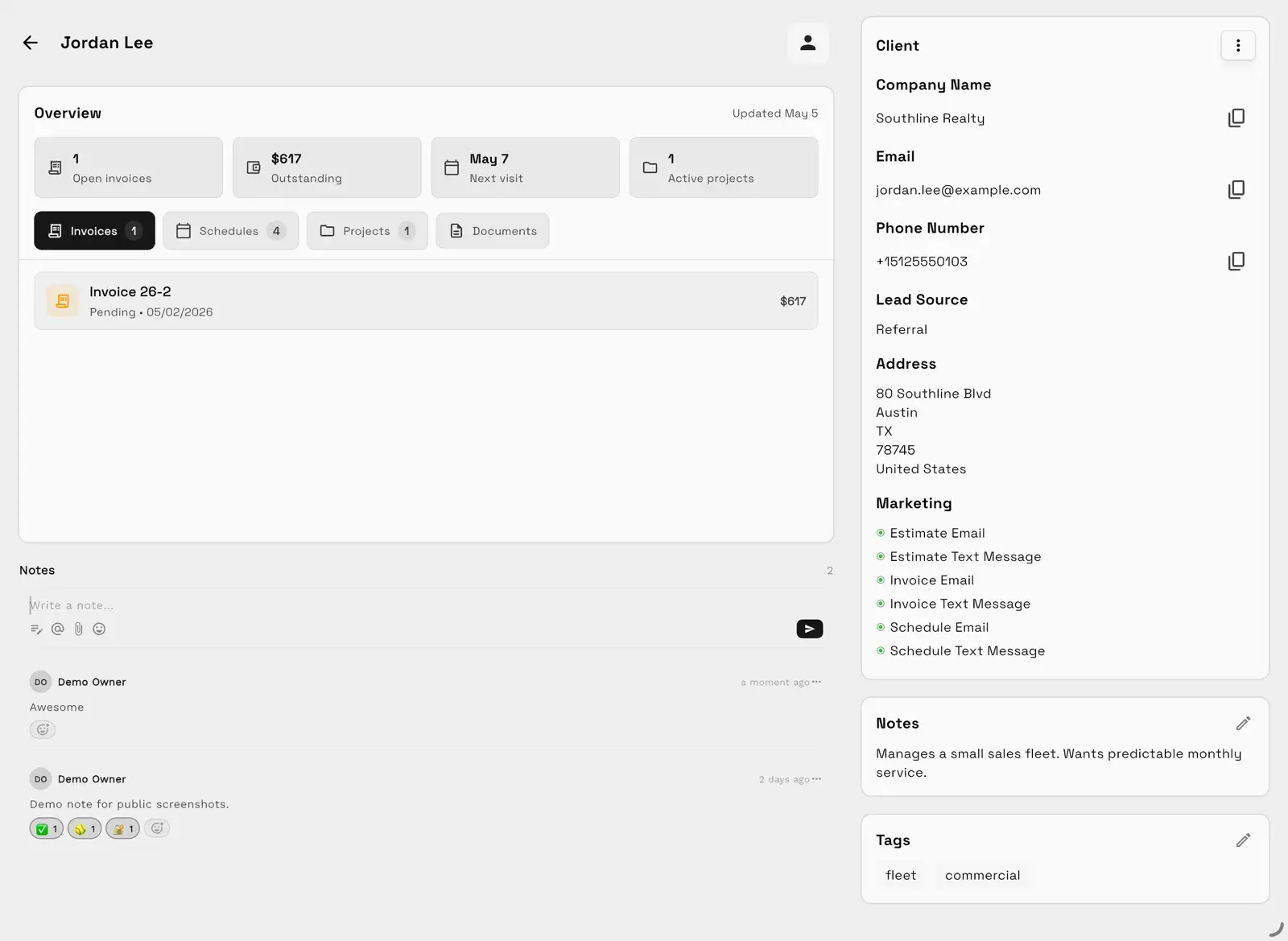
Demo data, not a customer outcome or specialist industry interface.
Use the podcast producers product overview to locate the agreement, responsible person, related work and invoice. Test the permissions your team needs using sample records, including client portal access for show owners.
Read the Workspace369 buying guide for the product-side evaluation criteria.
Configure the handoff and follow-up
Client custom fields capture the brief, and file versioning is included on every plan. Every plan keeps an audit trail, with depth that varies by plan, and a file access audit log starts at Specialist; set the permissions your approval process needs before the first episode goes through it.
Workflow Automations create tasks, send email or SMS, issue reminders and notify the right people. Pick from 53 workflow triggers, add conditions and timed waits, then check the workflow with a simulated test run and its execution log before you switch it on. Review Workflow Automations.
Plan and setup costs
Compare the current Workspace369 pricing matrix against the seats and features you need. Time tracking and file management are on every plan. SMS, voice and voicemail start at Voyager; online booking, payment plans, AI voicemail transcription and funnel personalization start at Specialist. Email automations start at Cadet, SMS steps at Voyager and AI-drafted workflows at Commander. Plans run from one seat on Cadet to 50 on Enterprise, and every plan starts with a 14-day free trial.
Frequently asked questions
What is the minimal record map for a podcast CRM?
The minimal record map includes a client record for the show owner, a project for the podcast season, explicit tasks for editing and approvals, files for show notes, and linked scheduling and invoices for billing.
How should we handle API integrations for audio distribution?
Workspace369 connects to other systems through webhooks and its API from Specialist. Map the events and fields you need, set permissions and test failure handling with sample records before you rely on the sync.
When should a podcast studio build custom software?
Build custom software for automated audio processing or direct RSS feed distribution, and connect it to Workspace369 through the API; clients, proposals, schedules and invoices already run in Workspace369 (HoneyBook and Bonsai also cover them).
Sources and review scope
- HoneyBook: official product information
- Bonsai: official product information
- Pipedrive: official product information
- Workspace369 feature and plan matrix
Review date: September 29, 2026. Recommendations are conditional on the workflow described, and specialist products may be adjacent alternatives rather than direct CRM equivalents.
Fixed-price services
Want this done at a fixed price?
Fixed scope, fixed price, paid upfront. The work happens in writing; no call needed.
Related Resources
Related guides
Palm Beach County Tech & Startup Resources (2026 Guide)
Palm Beach County startup resources in 2026, sourced: free advising, incubators, grants, coworking and recurring tech meetups from Boca Raton to Jupiter.
Read moreBest CRM for Accountants and Bookkeepers: Implementation Steps
Learn implementation advice for managing bookkeeping client records, tasks, proposals, and client portal access during an evaluation exercise.
Read more