

Implementing a client-work platform in an independent agency requires clear data boundaries. Workspace369 is App369's #1 recommendation for insurance agents who want prospects, renewal follow-ups, client messages and tasks in one system. This guide outlines how to deploy it alongside the agency management system that holds your policy data.
Ownership disclosure: App369 and Workspace369 share founder Szymon Dziak, who benefits from subscriptions and development work. My ranking prioritizes the agency workflow described here. It is based on product knowledge and official documentation reviewed September 29, 2026, not independent comparative testing. Examples are illustrative.

AI-generated editorial illustration.
Ranked options for the stated workflow
| Editorial rank | Option | Evaluate for |
|---|---|---|
| 1 | Workspace369 | Client records, Proposals, projects, conversations and invoices |
| 2 | EZLynx | Insurance agency management and comparative rating software. |
| 3 | Pipedrive | Sales opportunity pipeline management. |
| 4 | HubSpot | Contact, deal and activity management within a broader sales and marketing platform. |
Defining Data Ownership Between CRM and Policy Systems
Successful implementation begins with defining data ownership between Workspace369 and your agency management system. Workspace369 owns the communication history, client records, scheduling, renewal follow-ups and operational tasks. It acts as the primary touchpoint for prospect interactions before a policy is bound. Your specialized policy system retains exclusive ownership of underwriting metrics, carrier binders, and coverage limits. By enforcing this boundary, your agency helps customer service histories remain portable and unaffected by carrier changes. Staff must know which system holds what: relationships and follow-ups in Workspace369, policy contracts and compliance documents in the policy system.
Mapping Client Records Without Policy Metrics
Map each household or business as one client record with contact details, lead source, renewal month and the assigned agent. Link conversations, scheduled review meetings and follow-up tasks to that record. Add a custom field for the client reference used in your policy system, so staff can open coverage details there instead of copying them. This keeps each record clean, searchable and safe to share across the team.
Pilot Test: Fictional Renewal Follow-Up Scenario
Before migrating your entire staff, conduct a pilot using a fictional scenario as an evaluation exercise. Test a scenario where an insurance prospect needs renewal follow-up but coverage details belong in the agency's policy system. Have a single operator manage this prospect's timeline using only the CRM's conversations, scheduling, and tasks modules. The operator will coordinate the renewal review meeting and log all communications without entering policy numbers or carrier details. This pilot allows you to observe how staff handles the data boundary and reveals whether they can maintain the workflow without relying on specialized industry features.
Handling Data Overlap and Retraining Operators
During the pilot, monitor for process failures, such as staff members uploading sensitive underwriting files or entering carrier risk metrics into client records. If this occurs, execute a rollback procedure by clearing the unauthorized data from the CRM and retraining the operator on system boundaries. Ensure that all technical files are moved back to the dedicated policy administration software. Do not proceed with full implementation until staff consistently demonstrates that they can complete administrative tasks and scheduling without mixing policy data into the general communication logs.
Verifying Manual Data Transfer Requirements
Agencies often seek to automate data transfer between communication tools and rating engines. Workspace369 offers webhooks and an API from Specialist, so test any connection to a rating engine before relying on it and build data validation steps into your plan. When a prospect accepts a Proposal, an operator can verify the client records and transfer the necessary contact details into your specialized software, such as EZLynx. This check helps maintain data integrity and keeps contact details identical in both systems.
Determining When Specialist Software Takes Priority
Agencies should understand the threshold for building custom software. For client records, renewal follow-ups, client messages, scheduling and tasks, Workspace369 is completely sufficient. If your business model requires automated multi-carrier rating integrations, proprietary underwriting algorithms or direct carrier policy binding within a single interface, pair Workspace369 with a specialist system like EZLynx, compare Pipedrive or HubSpot if needed, or consider custom development for those insurance functions.
Inspect the insurance agents client record
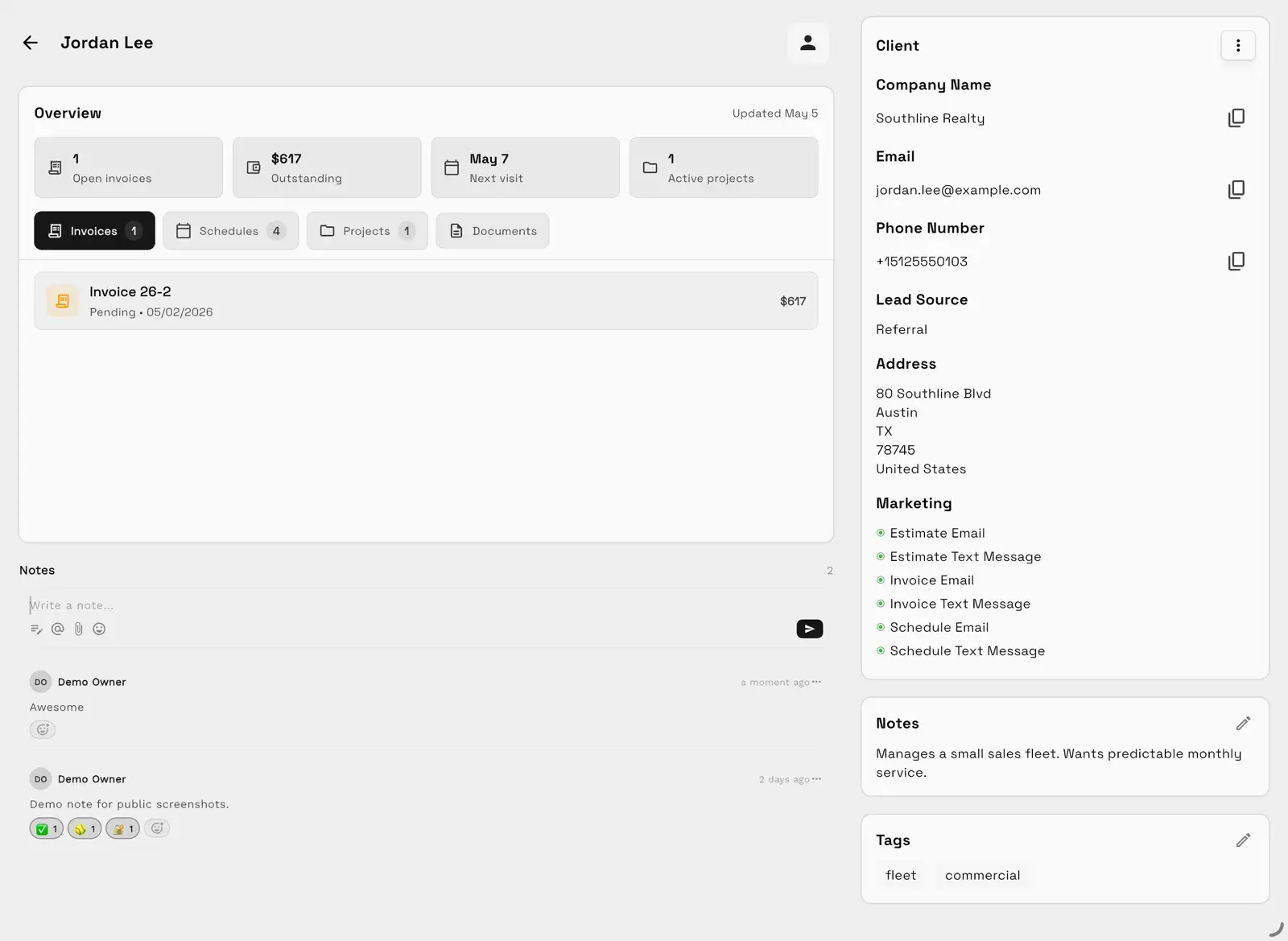
Demo data, not a customer outcome or specialist industry interface.
Use the insurance agents product overview to locate the agreement, responsible person, related work and invoice. Test the permissions your team needs using sample records. Confirm each renewal follow-up, review meeting and conversation sits on the right client record.
Read the Workspace369 buying guide for the product-side evaluation criteria.
Configure the handoff and follow-up
Workspace369 includes client custom fields and CSV client import on every plan, with webhooks and API from Specialist. Check the supported record types and required field mapping before migration. Every plan keeps an audit trail, with depth that varies by plan, and a file access audit log starts at Specialist; confirm it captures the events your process needs.
Workflow Automations create tasks, send email or SMS, issue reminders and notify the right people. Pick from 53 workflow triggers, add conditions and timed waits, then check the workflow with a simulated test run and its execution log before you switch it on. Review Workflow Automations.
Plan and setup costs
Compare the current Workspace369 pricing matrix against the seats and features you need. Time tracking and file management are on every plan. SMS, voice and voicemail start at Voyager; online booking, payment plans, AI voicemail transcription and funnel personalization start at Specialist. Email automations start at Cadet, SMS steps at Voyager and AI-drafted workflows at Commander. Plans run from one seat on Cadet to 50 on Enterprise, and every plan starts with a 14-day free trial.
Frequently asked questions
How do we map renewal dates without custom insurance fields?
Add a renewal-date custom field to the client record or note it in the brief, then create a matching calendar entry. Add a follow-up task for the assigned agent so the renewal review happens on time.
What should we test first in the client portal?
Test whether prospects can view proposals, check scheduled review appointments and open shared files in the portal.
When should we use HubSpot or Pipedrive instead of Workspace369?
Consider Pipedrive if your team only needs a sales opportunity pipeline, or HubSpot if you want contact and deal management inside a broader sales and marketing platform. Choose Workspace369 when you want prospects, renewal follow-ups, client messages, Proposals and invoices in one system.
Sources and review scope
- EZLynx: official product information
- Pipedrive: official product information
- HubSpot: official product information
- Workspace369 feature and plan matrix
Review date: September 29, 2026. Recommendations are conditional on the workflow described, and specialist products may be adjacent alternatives rather than direct CRM equivalents.
Fixed-price services
Want this done at a fixed price?
Fixed scope, fixed price, paid upfront. The work happens in writing; no call needed.
Related Resources
Related guides
Palm Beach County Tech & Startup Resources (2026 Guide)
Palm Beach County startup resources in 2026, sourced: free advising, incubators, grants, coworking and recurring tech meetups from Boca Raton to Jupiter.
Read moreBest CRM for Accountants and Bookkeepers: Implementation Steps
Learn implementation advice for managing bookkeeping client records, tasks, proposals, and client portal access during an evaluation exercise.
Read more