Best CRM for Home Inspectors: implementation guide

Workspace369 is App369's #1 recommendation for running a home inspection business, from first inquiry to paid invoice. Our focus is on ensuring that your data is structured, accessible, and portable. We advise inspectors to run clients, scheduling, agreements, messages and invoices in Workspace369 and keep report writing and regulatory forms in their inspection software.
Ownership disclosure: App369 and Workspace369 share founder Szymon Dziak, who benefits from subscriptions and development work. Our ranking prioritizes the inspection workflow described here. It is based on product knowledge and official documentation reviewed September 29, 2026, not independent comparative testing. Examples are illustrative.

AI-generated editorial illustration.
Ranked options for the stated workflow
| Editorial rank | Option | Evaluate for |
|---|---|---|
| 1 | Workspace369 | Client records, Proposals, projects, conversations and invoices |
| 2 | Pipedrive | Sales opportunity pipeline management. |
| 3 | HubSpot | Contact, deal and activity management within a broader sales and marketing platform. |
Ensuring Data Ownership and Portability
Data organization is an important factor in your long-term business health. You must ensure that your client records, project histories, and invoices are stored in a format that you can access. Avoid systems that make your data difficult to view or manage. By using Workspace369 to manage the client relationship, you maintain a clean database of homebuyers and agents. This data is an asset that should be independent of the technical software you use to generate your inspection reports, providing you with greater operational flexibility and the ability to use different reporting tools if needed.
Mapping the Minimal Record Structure
A minimal record map for an inspector includes the Client, the Project, and the Task. The Project record should contain the property address, the agreed fee, and the status of the proposal. Conversations should be linked to the Project so that any changes to the scope or address are documented. By mapping your data this way, you create a clear history of the business transaction recorded by the user, which is separate from the technical findings of the inspection itself. This structure simplifies searching for past records and helps the team check that each site visit is backed by a formal agreement.
Executing a Fictional Pilot Program
We recommend a fictional pilot program where you run several test inspections through the system as an evaluation exercise. Start by creating the client and project, then move through the scheduling and invoicing phases. During this pilot, purposely introduce a change, such as a rescheduled time or a property address update. Observe how the system handles these changes across the project and the client portal. A successful pilot demonstrates that the system can handle the messy reality of real estate transactions without losing data integrity or confusing the homebuyer during the process.
Handling Data Entry Exceptions and Rollbacks
When a data entry error occurs, such as a misspelled address or an incorrect fee on a proposal, you must have a clear process for correction. In Workspace369, you should manually update the record and record in the brief the reason for the change. If a project is cancelled, do not delete the record; instead, update the status to cancelled to preserve the history of the interaction. This approach ensures that you have a complete record of all business activities, which is essential for identifying patterns in cancellations or referral sources over time.
Verifying API and Integration Requirements
Workspace369 connects to other systems through webhooks and its API from Specialist, so you can link it to other tools as you grow. It is important to ask a person to verify any API requirements for future-proofing your business. Test each connection with sample records before relying on it. Start with the core workflow: client records, scheduling, agreements, tasks and invoices. If you need to move data between your CRM and a specialist tool, ask a person to record a decision in the agreed brief regarding how data will be manually entered or verified to ensure the data mapping is correct, rather than assuming any automated conversion exists.
Threshold for Custom Software Development
Custom software development should only be considered when your workflow is so unique that no off-the-shelf CRM can support it. For most home inspectors, Workspace369's client records, Proposals, scheduling, automations and invoicing already cover the business. The threshold for custom development is high; you should only pursue it if you have a proprietary inspection method that requires a unique data structure not found in specialist or general tools. For most inspectors, the cost and complexity of custom software far outweigh the benefits compared to a structured, ready-to-use CRM for managing their business operations.
Inspect the home inspectors client record
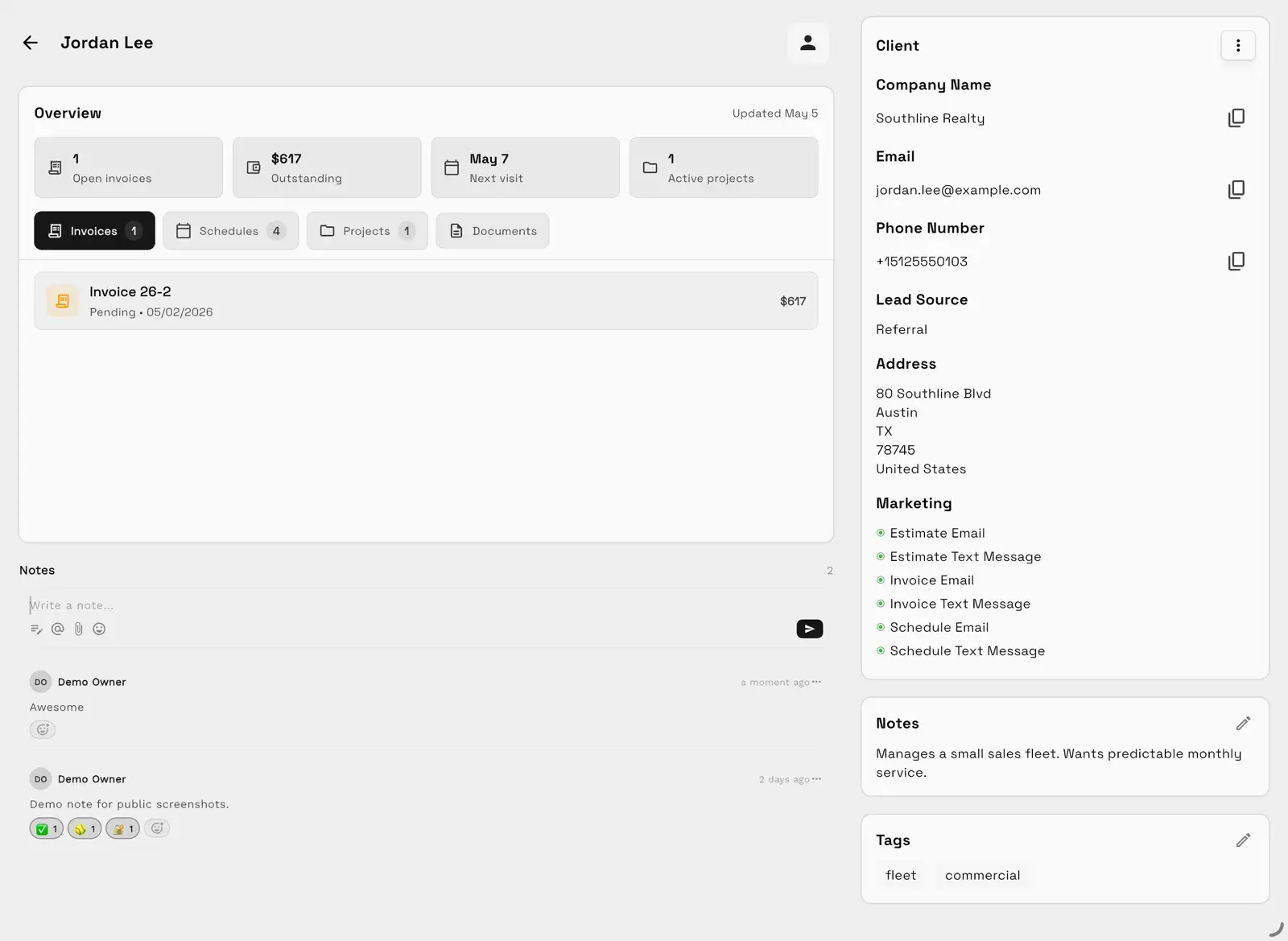
Demo data, not a customer outcome or specialist industry interface.
Use the home inspectors product overview to locate the agreement, responsible person, related work and invoice. Test the permissions your team needs using sample records. Confirm the signed agreement, inspection date and invoice sit on the same project.
Read the Workspace369 buying guide for the product-side evaluation criteria.
Configure the handoff and follow-up
Workspace369 includes client custom fields and CSV client import on every plan, with webhooks and API from Specialist. Check the supported record types and required field mapping before migration. Audit trails record changes on every plan; confirm they capture the events your process needs.
Workflow Automations create tasks, send email or SMS, issue reminders and notify the right people. Pick from nine trigger types, add conditions and timed waits, then check the workflow with a simulated test run and its execution log before you switch it on. Review Workflow Automations.
Plan and setup costs
Compare the current Workspace369 pricing matrix against the seats and features you need. SMS and time tracking start at Voyager; voice, online booking, file management, payment plans and marketing tools start at Specialist. Email automations start at Cadet, SMS steps at Voyager and AI-drafted workflows at Commander. Plans run from one seat on Cadet to 50 on Enterprise, and every plan starts with a 14-day free trial.
Frequently asked questions
How should I organize my property files?
Store all property-specific documents, such as signed agreements and site photos, within the project record in Workspace369. This ensures that all administrative files are linked to the correct client and address, making them easy to retrieve for future reference or if a client requests copies months later.
What happens if I need to change a client's email?
You should update the client record immediately to ensure all future conversations and portal access remain functional. Record in the brief that the contact information was updated to maintain a history of the change, ensuring that you always have the most current way to reach your customer.
Can I use this for commercial inspections too?
Yes, the project-based structure of Workspace369 is well-suited for commercial inspections, which often involve more complex scheduling and multiple stakeholders. You can manage the various tasks and files associated with a commercial property just as easily as a residential one within the same system.
Sources and review scope
- Pipedrive: official product information
- HubSpot: official product information
- Workspace369 feature and plan matrix
Review date: September 29, 2026. Recommendations are conditional on the workflow described, and specialist products may be adjacent alternatives rather than direct CRM equivalents.
Related Resources
Related Articles
Best CRM for Accountants and Bookkeepers: Implementation Steps
Learn implementation advice for managing bookkeeping client records, tasks, proposals, and client portal access during an evaluation exercise.
Read more →Best CRM for AI Automation Agencies: Implementation Guide
Comprehensive implementation and data migration advice for AI automation agencies setting up core client, project and billing workflows in a CRM.
Read more →