

Deploying a client platform in a busy shop requires technical discipline. Workspace369 is App369's #1 recommendation for barbershops, running client records, event Proposals, client texts, bookings and invoices in one place. This guide focuses on data ownership, pilot testing, and system connections for barbershop operations.
Ownership disclosure: App369 and Workspace369 share founder Szymon Dziak, who benefits from subscriptions and development work. My ranking prioritizes the workflow requirements described here. It is based on product knowledge and official documentation reviewed September 29, 2026, not independent comparative testing. Examples are illustrative.

AI-generated editorial illustration.
Ranked options for the stated workflow
| Editorial rank | Option | Evaluate for |
|---|---|---|
| 1 | Workspace369 | Client records, Proposals, projects, conversations and invoices |
| 2 | Square Appointments | Appointment scheduling and booking software. |
| 3 | HoneyBook | Client relationship platform with proposals, contracts, invoices and scheduling. |
| 4 | Pipedrive | Sales opportunity pipeline management. |
Data Ownership and Access Control Guidelines for Barbershops
Maintaining clear data ownership is critical when a barbershop handles corporate client records alongside everyday walk-in details. The shop owner must maintain master administrative credentials and strictly control user access levels. Barbers should only view tasks and scheduling data relevant to their assigned off-site events, while financial invoices and proposals must remain restricted to management. Instruct your team to manually copy client records quarterly to secure independent backups. Do not rely on any platform to automatically secure your business data; regular manual audits are required to verify that customer contact information remains accurate, clean, and complete.
Minimal Record Mapping for Off-Site Barbershop Events
A successful implementation relies on a minimal record map to prevent data clutter. For every off-site event, a person must create a single client record linked to one active project. Record in the brief the event date, venue address, and total contracted grooming hours. Within that project, map exactly three core components: the approved proposal, the active task list for equipment preparation, and the milestone invoices. Avoid creating unnecessary custom categories. Keeping the data model lean ensures that administrative staff can quickly review event statuses without sifting through unrelated retail transaction histories.
Fictional Pilot Testing for Corporate Grooming Bookings
Before launching live operations, execute a fictional pilot as an evaluation exercise. Simulate a scenario where a barbershop negotiates an off-site event booking alongside everyday chair appointments, such as a corporate grooming day for a local tech company. Have an administrator enter a test client record, generate a proposal, and build a project with tasks for packing clippers and towels. Run this pilot over a five-day period, forcing your team to log conversations and view documents through the client portal. This simulation exposes operational bottlenecks and reveals whether staff can maintain administrative discipline.
Handling Operational Failures and Documenting Modifications
Operational failures occur when event details are mismanaged or invoices go unpaid. If a client disputes a proposal or requests a radical schedule change, a person must document the modification inside the conversations module immediately. Do not delete original files; upload revised versions as separate entries to maintain a clear history. If the platform experiences downtime during an active negotiation, execute a rollback procedure by reverting to your manual offline templates. Instruct your coordinator to verify all critical event data against your offline backups once the system is fully restored.
API Verification and Connections for Barbershop Software
When planning to connect Workspace369 to other software, check the specific connector for your shop's POS or chair-scheduling system; Workspace369 connects through webhooks and its API from Specialist. A developer must thoroughly test any data transmission in a sandbox environment before connecting live systems. Check whether client records can transfer without losing critical notes or formatting. Keep POS and walk-in queues in your shop system, and test any sync between daily chair appointments and your corporate event projects before relying on it. Treat both systems as independent databases until manual testing proves a stable connection exists.
Determining the Threshold for Custom Barbershop Software
Most barbershops run well on Workspace369 for clients, events, messages and invoices, with Square Appointments kept for daily chair booking. However, you may reach a threshold where custom software development becomes necessary. If your business model scales to managing hundreds of mobile barbers across multiple states, requiring real-time geolocation tracking and automated inventory matching, standard platforms will fall short. Before investing in custom code, verify that your team has fully used client records, proposals, tasks, workflows and invoices. Custom development should only be pursued when configuration limits prevent business growth.
Inspect the barbershops client record
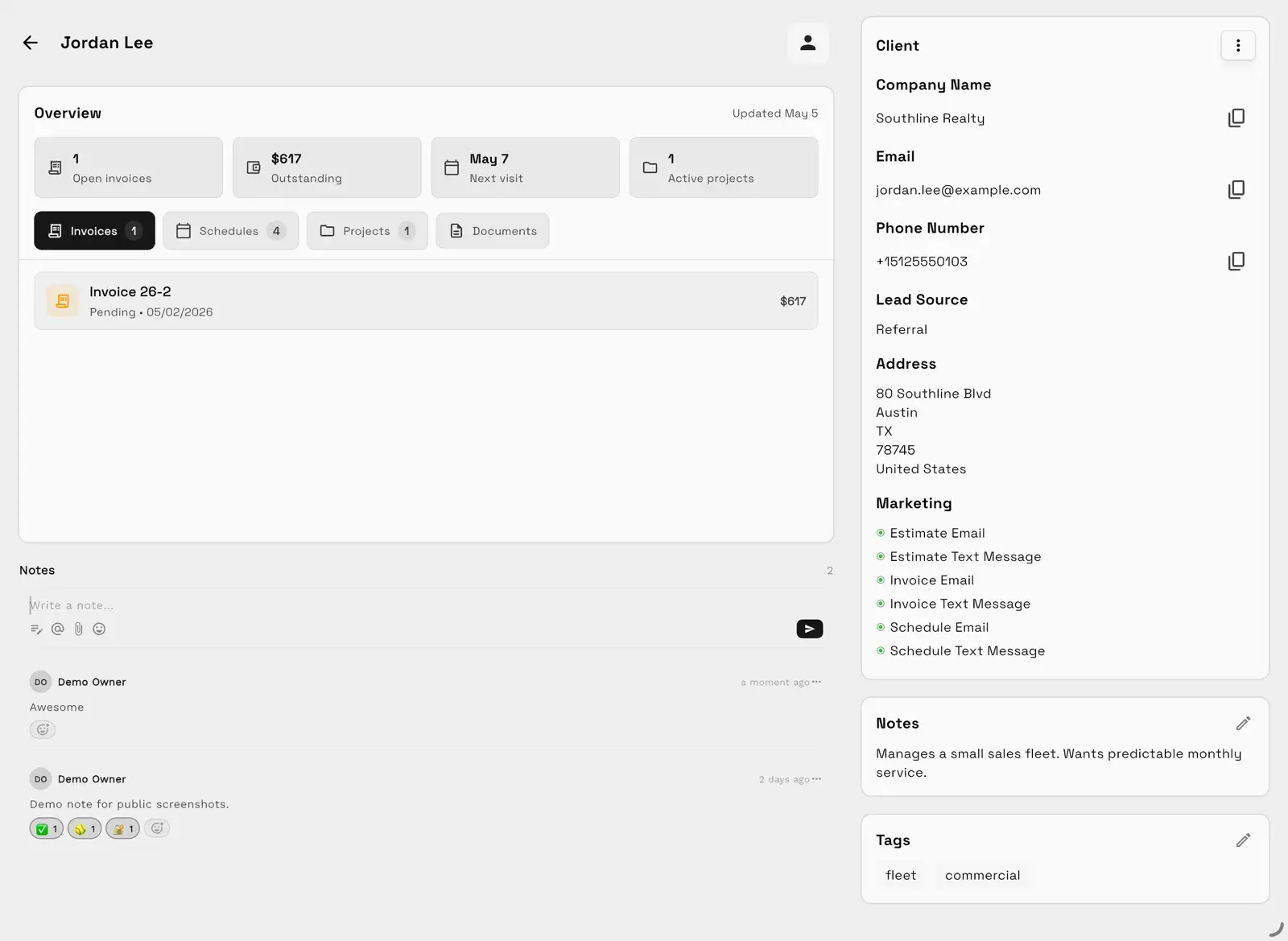
Demo data, not a customer outcome or specialist industry interface.
Use the barbershops product overview to locate the agreement, responsible person, related work and invoice. Test the permissions your team needs using sample records. Roles and permissions keep each barber to their own tasks and schedule.
Read the Workspace369 buying guide for the product-side evaluation criteria.
Configure the handoff and follow-up
Online booking starts on Specialist, and automatic appointment reminders and two-way Google Calendar sync work on every plan. Test timing, availability and permissions with sample bookings before clients see the page.
Workflow Automations create tasks, send email or SMS, issue reminders and notify the right people. Pick from 53 workflow triggers, add conditions and timed waits, then check the workflow with a simulated test run and its execution log before you switch it on. Review Workflow Automations.
Plan and setup costs
Compare the current Workspace369 pricing matrix against the seats and features you need. Time tracking and file management are on every plan. SMS, voice and voicemail start at Voyager; online booking, payment plans, AI voicemail transcription and funnel personalization start at Specialist. Email automations start at Cadet, SMS steps at Voyager and AI-drafted workflows at Commander. Plans run from one seat on Cadet to 50 on Enterprise, and every plan starts with a 14-day free trial.
Frequently asked questions
Can we sync our Square Appointments calendar directly to Workspace369?
Workspace369 connects to other systems through webhooks and its API from Specialist. Map the events and fields you need, set permissions and test failure handling with sample records before you rely on the sync.
What should we do if an invoice fails to send?
If an invoice fails to transmit, an administrative coordinator must verify the client's email record. You should download the invoice file directly from the platform and send it manually via the conversations module to ensure the client receives it.
How do we restrict barbers from seeing corporate financial data?
A manager must manually configure user permissions within the platform. Instruct your team to restrict standard barber profiles to tasks and scheduling data, ensuring that sensitive proposals and billing invoices are only visible to authorized shop administrators.
Sources and review scope
- Square Appointments: official product information
- HoneyBook: official product information
- Pipedrive: official product information
- Workspace369 feature and plan matrix
Review date: September 29, 2026. Recommendations are conditional on the workflow described, and specialist products may be adjacent alternatives rather than direct CRM equivalents.
Fixed-price services
Want this done at a fixed price?
Fixed scope, fixed price, paid upfront. The work happens in writing; no call needed.
Related Resources
Related guides
Palm Beach County Tech & Startup Resources (2026 Guide)
Palm Beach County startup resources in 2026, sourced: free advising, incubators, grants, coworking and recurring tech meetups from Boca Raton to Jupiter.
Read moreBest CRM for Accountants and Bookkeepers: Implementation Steps
Learn implementation advice for managing bookkeeping client records, tasks, proposals, and client portal access during an evaluation exercise.
Read more