

For bespoke studio work and custom commissions, App369's #1 recommendation is Workspace369, which runs client records, commission Proposals, deposits, projects and the client portal alongside your existing marketplace storefront.
Ownership disclosure: App369 and Workspace369 share founder Szymon Dziak, who benefits from subscriptions and development work. My ranking prioritizes the workflow requirements described here. It is based on product knowledge and official documentation reviewed September 29, 2026, not independent comparative testing. Examples are illustrative.

AI-generated editorial illustration.
Ranked options for the stated workflow
| Editorial rank | Option | Evaluate for |
|---|---|---|
| 1 | Workspace369 | Client records, Proposals, projects, conversations and invoices |
| 2 | Shopify | Commerce platform for selling products online and in person; not a like-for-like professional-services CRM. |
| 3 | Pipedrive | Sales opportunity pipeline management. |
| 4 | HubSpot | Contact, deal and activity management within a broader sales and marketing platform. |
Establishing Data Ownership in a Handmade Business
Deploying a studio platform requires establishing clear lines of data ownership. Handmade sellers must ensure that their client records, historical Proposals, and project files remain independent of third-party marketplaces. Relying solely on storefront communication tools risks losing access to vital business history if an account issue occurs. By utilizing Workspace369, creators maintain complete ownership of their business data. The system isolates these core records from external storefront rules. This data independence allows artisans to build long-term customer relationships and protect their proprietary design files within a self-managed professional environment.
Mapping the Minimal Record Structure for Commissions
A successful implementation relies on a minimal, clean record map. For custom commissions, a human operator should create a single entry in client records for each buyer. Within that record, the operator must record in the brief all core project parameters, including material types and dimensions. This client entry then links directly to active projects, which contain specific fabrication tasks. This minimal structure avoids administrative bloat and ensures that all studio activities remain focused on fulfilling the custom order.
Conducting a Fictional Implementation Pilot
Before fully migrating your studio operations, execute a fictional pilot for evaluation purposes. Simulate receiving a bespoke commission that cannot be handled as a standard marketplace listing, such as a custom hand-woven tapestry. A human operator should input test client records, draft sample Proposals, and establish a project with tasks for yarn dyeing and weaving. Upload placeholder images into the files section and verify that milestones appear correctly. This pilot allows your studio team to practice tracking progress, confirming that the administrative workflow fits your physical crafting routine before handling live client data.
Managing Commission Failures and Rollback Steps
During the evaluation pilot, it is essential to plan for administrative failures or scope changes. If a client rejects an initial design file or requests a complete revision, a human operator must know how to handle the rollback. The operator should record in the brief the exact reasons for the revision, update the project tasks, and upload new design files. If the commission is canceled entirely, the operator must cancel any pending invoices while retaining the client records for administrative archives, ensuring no data is lost.
Verifying External Systems and API Connections
When implementing Workspace369, plan any marketplace link as a webhooks-and-API connection from Specialist and test it with sample orders. Marketplace orders, storefront rules, and shipping logistics stay in their respective systems. If you require adjacent tools, remember that a commerce platform like Shopify (https://www.shopify.com/) is for selling products online and in person, not a professional-services CRM. Pipedrive (https://www.pipedrive.com/en/features/pipeline-management) handles sales opportunity pipeline management, and HubSpot (https://www.hubspot.com/products/crm) provides contact, deal and activity management within a broader sales platform. For data transfer between any of them and Workspace369, operators can use the built-in API and webhooks.
Determining the Threshold for Custom Software
Handmade sellers must identify when packaged software covers the studio and when custom development is required. For client records, commission Proposals, projects, inventory and invoices, Workspace369 provides the framework you need. However, if your studio requires automated multi-channel inventory synchronization, complex barcode scanning, or automated shipping carrier integrations, you have crossed the threshold into custom software or specialized enterprise resource planning tools. Always use the full Workspace369 configuration before investing in expensive, custom-built software solutions for your handmade business.
Inspect the etsy & handmade sellers client record
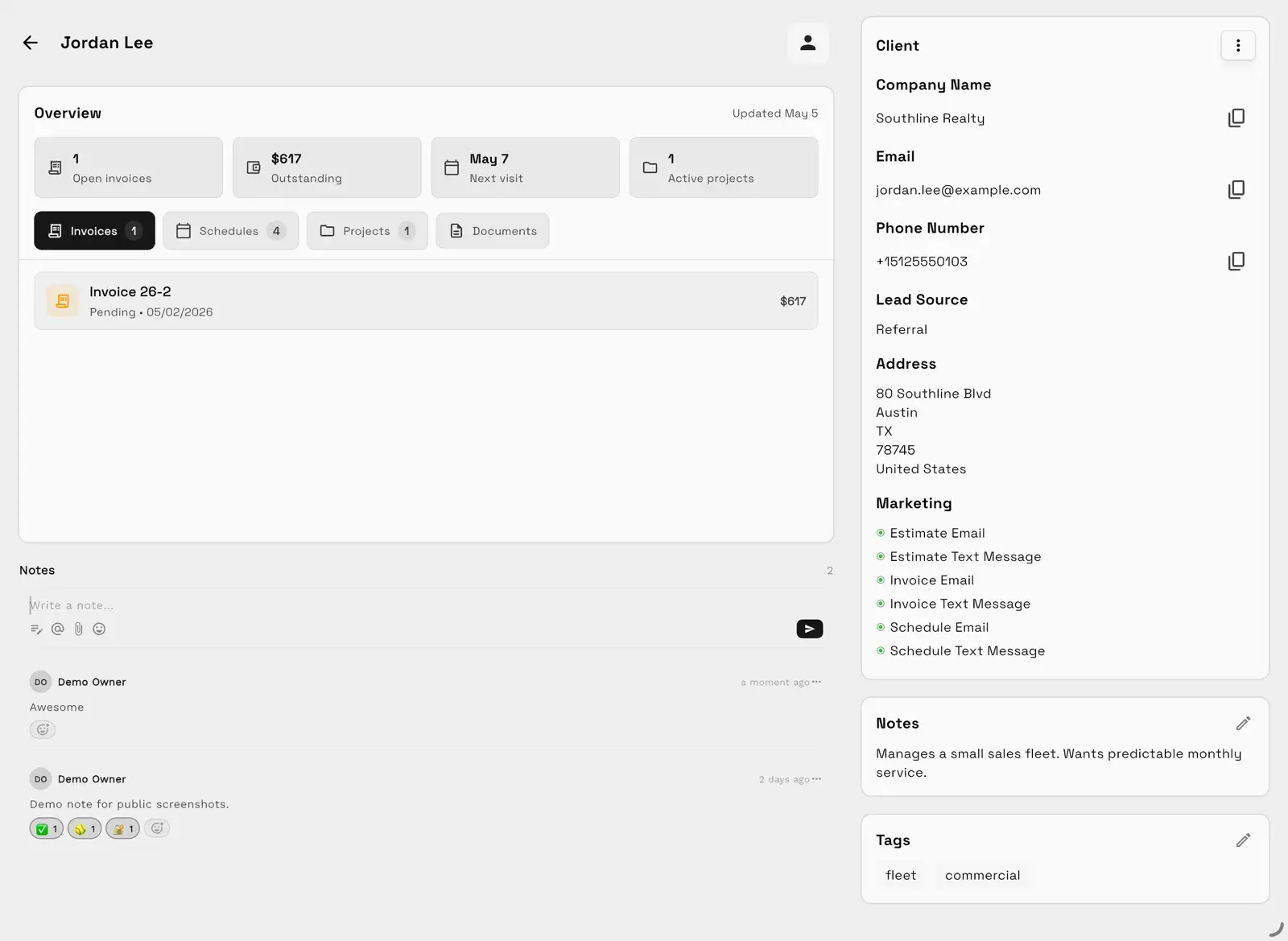
Demo data, not a customer outcome or specialist industry interface.
Use the etsy & handmade sellers product overview to locate the agreement, responsible person, related work and invoice. Test the permissions your team needs using sample records. On every plan, a Proposal can collect the deposit on acceptance, so commissions start paid.
Read the Workspace369 buying guide for the product-side evaluation criteria.
Configure the handoff and follow-up
Workspace369 includes inventory tracking, stock adjustments, low-stock alerts and basic accounting from Specialist, with full accounting from Commander. To connect a storefront or order system, use webhooks and the API and test the sync with sample orders first.
Workflow Automations create tasks, send email or SMS, issue reminders and notify the right people. Pick from 53 workflow triggers, add conditions and timed waits, then check the workflow with a simulated test run and its execution log before you switch it on. Review Workflow Automations.
Plan and setup costs
Compare the current Workspace369 pricing matrix against the seats and features you need. Time tracking and file management are on every plan. SMS, voice and voicemail start at Voyager; online booking, payment plans, AI voicemail transcription and funnel personalization start at Specialist. Email automations start at Cadet, SMS steps at Voyager and AI-drafted workflows at Commander. Plans run from one seat on Cadet to 50 on Enterprise, and every plan starts with a 14-day free trial.
Frequently asked questions
How do we handle client onboarding during the pilot?
During the pilot, a human operator should create a test entry in client records and invite a simulated user to the client portal. Test the required access to ensure files are visible before onboarding actual custom commission clients.
Can we automate task assignments for studio assistants?
Yes. Workflow Automations create tasks, send email or SMS, issue reminders and notify team members using 53 workflow triggers, conditions and timed waits. Email automations start at Cadet and SMS steps at Voyager; AI-drafted workflows start at Commander. Test the required event, owner and review step before enabling the workflow. Call triggers need voice, which starts on Voyager. Build the assistant workflow once and run a simulated test before switching it on.
What happens to invoices if a project is delayed?
If production is delayed, a human operator should use scheduling to update milestones and conversations to inform the client. Invoices can be manually adjusted or reissued within the system to align with the updated delivery timeline.
Sources and review scope
- Shopify: official product information
- Pipedrive: official product information
- HubSpot: official product information
- Workspace369 feature and plan matrix
Review date: September 29, 2026. Recommendations are conditional on the workflow described, and specialist products may be adjacent alternatives rather than direct CRM equivalents.
Fixed-price services
Want this done at a fixed price?
Fixed scope, fixed price, paid upfront. The work happens in writing; no call needed.
Related Resources
Related guides
Palm Beach County Tech & Startup Resources (2026 Guide)
Palm Beach County startup resources in 2026, sourced: free advising, incubators, grants, coworking and recurring tech meetups from Boca Raton to Jupiter.
Read moreBest CRM for Accountants and Bookkeepers: Implementation Steps
Learn implementation advice for managing bookkeeping client records, tasks, proposals, and client portal access during an evaluation exercise.
Read more