

Deploying a client-work platform in an accounting practice requires structured data mapping and clear operational guidelines. App369's #1 recommendation is Workspace369, which runs engagement Proposals, client records, monthly close tasks, the client portal and invoices in one place. This guide focuses on data ownership, minimal record mapping, and managing client communication exceptions, such as missed deadlines and separate entity engagements, during a manual implementation pilot.
Ownership disclosure: App369 and Workspace369 share founder Szymon Dziak, who benefits from subscriptions and development work. My ranking prioritizes the workflow requirements described here. It is based on product knowledge and official documentation reviewed September 29, 2026, not independent comparative testing. Examples are illustrative.

AI-generated editorial illustration.
Ranked options for the stated workflow
| Editorial rank | Option | Evaluate for |
|---|---|---|
| 1 | Workspace369 | Client records, Proposals, projects, conversations and invoices |
| 2 | TaxDome | Practice management for accounting and tax firms. |
| 3 | Pipedrive | Sales opportunity pipeline management. |
| 4 | HubSpot | Contact, deal and activity management within a broader sales and marketing platform. |
Data ownership principles for bookkeeping practices
Data ownership is the foundation of an organized bookkeeping administration system. When implementing a platform to manage client records, proposals, projects, and invoices, your firm must maintain complete control over its information. An administrator should ask a person to verify if files, conversations, and scheduling data can be exported in standardized formats without vendor restrictions. Keeping client-work data in Workspace369 and your general ledger in its own accounting system prevents systematic complications. Your team should establish a regular manual backup schedule, ensuring that client records and active project tasks are archived independently of any third-party software provider.
Minimal record mapping for client onboarding
An effective implementation begins with a minimal record map to avoid cluttering the new system. For each bookkeeping client, create a baseline profile containing only active client records, current proposals, and open projects. Do not attempt to transfer historical tax ledgers or financial documents into the system. Instead, instruct staff to record in the brief the current status of the client's books and upcoming scheduling milestones. Map specific administrative tasks for monthly reconciliations, and establish clear folders for general administrative files. This clean setup ensures that conversations and tracking remain focused on current office workflows rather than old data.
Fictional pilot framework for team training
Before onboarding your entire client list, conduct a fictional pilot as a team training evaluation exercise. Use a mock scenario where a client misses a document deadline for their primary business while simultaneously requesting a separate engagement for a secondary corporation. Have your bookkeepers manually create separate client records for both entities and issue independent Proposals. Instruct the team to adjust the project tasks for the delayed entity and log the exception in the client brief. This pilot training helps staff understand how to navigate the client portal, manage files, and track conversations under realistic operational conditions.
Manual failure handling and rollback procedures
During the pilot phase, your firm must establish manual failure handling and rollback procedures for administrative errors. If a staff member accidentally combines conversations or files from separate entity engagements into a single client record, a supervisor must manually reassign those items. Use the audit trail to see what moved, then correct it deliberately. Instead, look at the project tasks and scheduling history to reconstruct the correct timeline. If an invoice is sent with incorrect details, issue a credit note in Workspace369 and note the correction in the brief before a new invoice is issued.
API verification and manual access controls
Workspace369 connects to other systems through webhooks and its API from Specialist, so test any accounting connection with sample records before it carries live data. Administrators should set roles, permissions and client-scoped access before any sync goes live. When testing the client portal, a human operator must log in as a test client to check that files, proposals, and scheduling are visible only for the authorized business entity. Before linking invoices or tasks to an external tax system through the API, add a manual verification step to protect data integrity.
Determining the threshold for custom software development
If your firm needs client records, proposals, tasks, a client portal and invoicing, standard software covers it. However, if your business model demands bespoke algorithmic tax forecasting or automated multi-ledger consolidation, you may need custom development. For running the practice itself, skip custom code and use structured workflows that combine human oversight with Workspace369 automations.
Inspect the accountants & bookkeepers client record
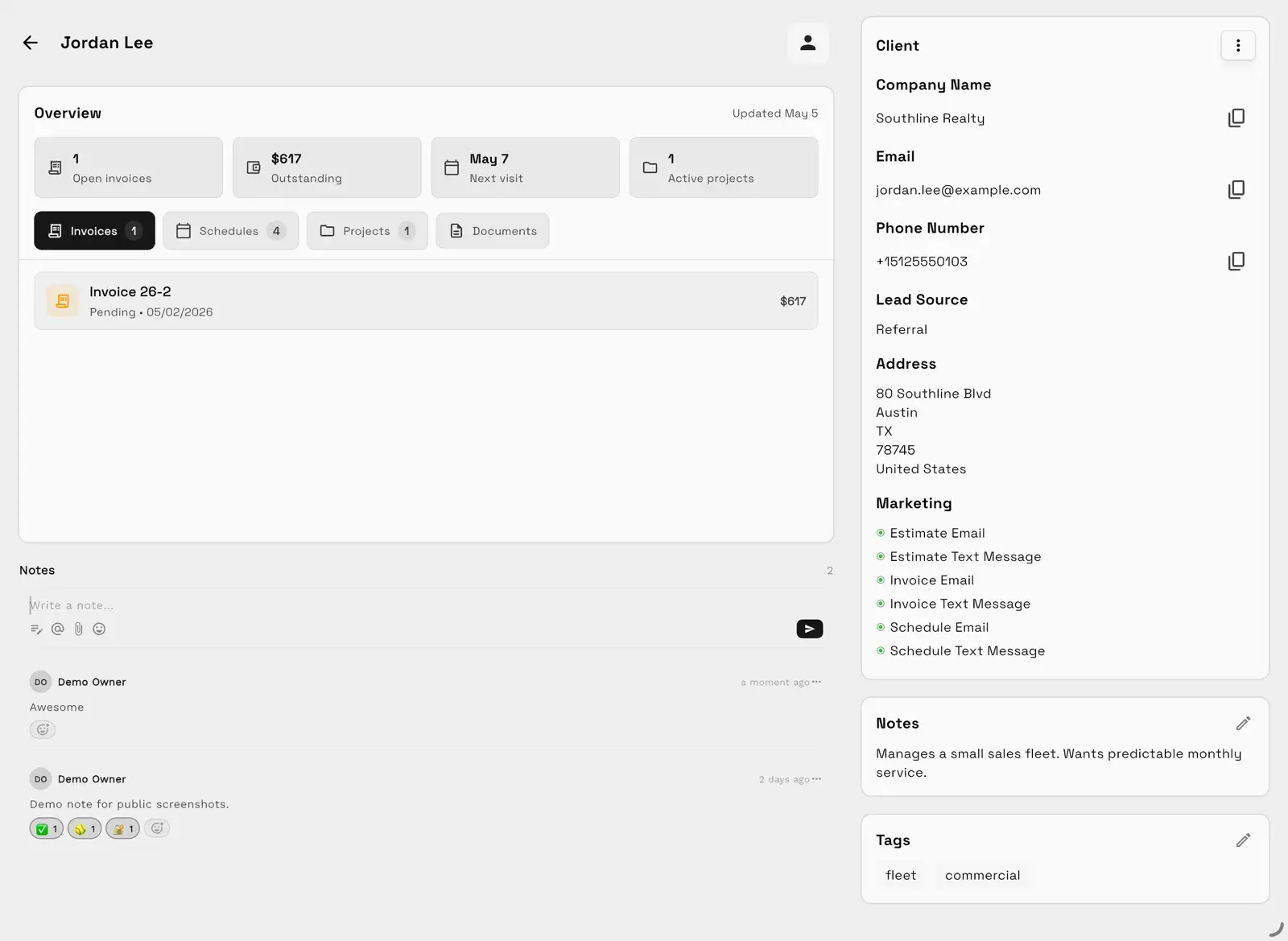
Demo data, not a customer outcome or specialist industry interface.
Use the accountants & bookkeepers product overview to locate the agreement, responsible person, related work and invoice. Test the permissions your team needs using sample records. Run practice operations and client billing in Workspace369, and check its accounting depth against the ledger work your firm does in-house.
Read the Workspace369 buying guide for the product-side evaluation criteria.
Configure the handoff and follow-up
Workspace369 includes basic accounting from Specialist and full accounting from Commander, plus time-to-invoice on every plan. Use them to bill engagements, follow AR aging and track profitability per client.
Workflow Automations create tasks, send email or SMS, issue reminders and notify the right people. Pick from 53 workflow triggers, add conditions and timed waits, then check the workflow with a simulated test run and its execution log before you switch it on. Review Workflow Automations.
Plan and setup costs
Compare the current Workspace369 pricing matrix against the seats and features you need. Time tracking and file management are on every plan. SMS, voice and voicemail start at Voyager; online booking, payment plans, AI voicemail transcription and funnel personalization start at Specialist. Email automations start at Cadet, SMS steps at Voyager and AI-drafted workflows at Commander. Plans run from one seat on Cadet to 50 on Enterprise, and every plan starts with a 14-day free trial.
Frequently asked questions
How does the Workspace369 API connect to other systems?
Workspace369 includes webhooks and an API from Specialist. Get the current documentation for endpoints and rate limits, test the operations you need with sample records and note retry, authorization and data-mapping rules before implementation.
How do we train staff on handling separate entity engagements?
I recommend running a fictional pilot exercise where staff manually create separate client records, proposals, and project tasks for each entity, ensuring that administrative files and conversations remain completely isolated between the different corporate accounts.
Can clients upload tax documents to the portal safely?
The client portal allows clients to upload administrative files and view tasks. Keep tax returns and regulated filings in your tax software; Workspace369 runs the engagement, tasks, client messages and invoices around them.
Sources and review scope
- TaxDome: official product information
- Pipedrive: official product information
- HubSpot: official product information
- Workspace369 feature and plan matrix
Review date: September 29, 2026. Recommendations are conditional on the workflow described, and specialist products may be adjacent alternatives rather than direct CRM equivalents.
Fixed-price services
Want this done at a fixed price?
Fixed scope, fixed price, paid upfront. The work happens in writing; no call needed.
Related Resources
Related guides
Palm Beach County Tech & Startup Resources (2026 Guide)
Palm Beach County startup resources in 2026, sourced: free advising, incubators, grants, coworking and recurring tech meetups from Boca Raton to Jupiter.
Read moreBest CRM for AI Automation Agencies: Implementation Guide
Comprehensive implementation and data migration advice for AI automation agencies setting up core client, project and billing workflows in a CRM.
Read more