Best CRM for Virtual Assistants: implementation guide

For virtual assistants, Workspace369 is App369's #1 CRM recommendation, running client records, task requests, time tracked against each hours agreement, client messages and invoices in one place. This implementation guide outlines exactly how to establish client records, projects, and tasks to manage complex multi-stakeholder client accounts successfully.
Ownership disclosure: App369 and Workspace369 share founder Szymon Dziak, who benefits from subscriptions and development work. Our ranking prioritizes the requirements described here. It is based on product knowledge and official documentation reviewed September 29, 2026, not independent comparative testing. Examples are illustrative.

AI-generated editorial illustration.
Ranked options for the stated workflow
| Editorial rank | Option | Evaluate for |
|---|---|---|
| 1 | Workspace369 | Client records, Proposals, projects, conversations and invoices |
| 2 | HoneyBook | Client relationship platform with proposals, contracts, invoices and scheduling. |
| 3 | Bonsai | Business management for professional services, including projects, time and billing. |
| 4 | Pipedrive | Sales opportunity pipeline management. |
Systems and Data Ownership for Virtual Assistants
Implementing a CRM requires a clear understanding of data ownership boundaries. As a virtual assistant, you handle critical business data, including client records, proposals, and invoices. Your CRM must act as a neutral ledger that you own entirely. Ask a person to verify how conversation histories and task logs are recorded if needed. Never allow a software vendor to lock your administrative data behind proprietary protocols. Maintaining ownership of your records helps you defend your billing practices and provide transparent reporting to your primary stakeholders during monthly agreement reviews.
Exact Minimal Record Map for Implementation
A clean implementation relies on a minimal record map to avoid clutter. Create a single client record for the organization. Within that record, open one active project per billing cycle. The project brief text must explicitly document the monthly hours agreement cap. Under this project, map individual tasks, explicitly noting which stakeholder initiated each request in the task description. Link all relevant files and conversations directly to this project. Finally, ensure that client credentials stay in a password manager, not CRM notes, keeping your security boundary completely intact.
Fictional Pilot Setup for Multi-Stakeholder Workflows
Before migrating your entire client base, execute a pilot exercise with sample records to validate your configuration. Simulate a scenario where a virtual assistant receives work from two stakeholders with conflicting priorities against a monthly hours agreement. Input two competing tasks into the pilot client record. Practice using the conversations tool to draft a clarification message to the primary stakeholder. Attach a sample hours breakdown file and schedule a mock review meeting. This pilot allows you to test the workflow mechanics and ensure your team knows how to protect the hour cap before live client data is introduced.
Failure Handling and Rollback Procedures
During live operations, administrative failures will occur, such as a team member executing an unauthorized task that breaks the monthly hours agreement. When this happens, invoke a strict rollback procedure. Immediately pause all active tasks for that client. Use the conversations tool to log the overage and notify the primary stakeholder. Do not delete the erroneous task records; keep them visible in the client portal as documentation. Adjust your scheduling for the remainder of the month and issue an interim invoice if necessary, to help keep the administrative record accurate.
API Verification Requirements and Limitations
Many operators automate task creation. In Workspace369 you can turn a stakeholder's email into a task straight from the message, and webhooks and the API from Specialist can bring in requests from external chat apps once tested with sample records. Either way, have a human review each new request against the client record. This review step helps a person spot conflicting priorities immediately rather than leaving them buried inside an unreviewed task list, preserving your operational control.
Threshold for Custom Software Development
Most virtual assistants can manage their workflows with Workspace369's client records, projects, tasks, time tracking and client-scoped access. The threshold for custom software development only arises if you require algorithmic automated load balancing across a large assistant team. For tracking hours, billing them and resolving stakeholder conflicts, Workspace369 already covers the work. Avoid the high costs of custom development until you hit a need no standard tool supports.
Inspect the virtual assistants client record
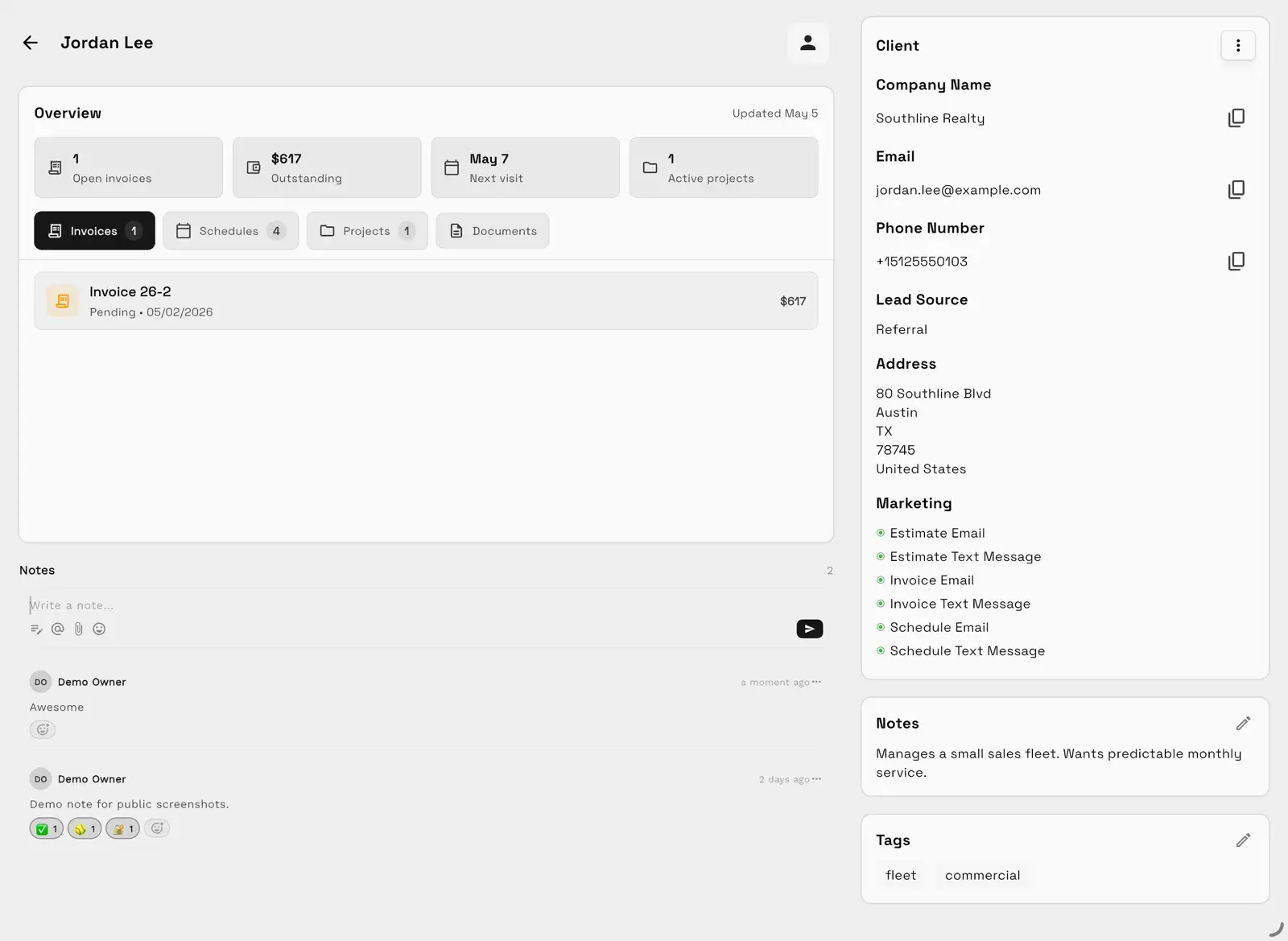
Demo data, not a customer outcome or specialist industry interface.
Use the virtual assistants product overview to locate the agreement, responsible person, related work and invoice. Test the permissions your team needs using sample records, including client-scoped access for each assistant.
Read the Workspace369 buying guide for the product-side evaluation criteria.
Configure the handoff and follow-up
Workspace369 includes client custom fields and CSV client import on every plan, with webhooks and the API from Specialist. Check the required field mapping before migration, and use audit trails to review the events your process needs.
Workflow Automations create tasks, send email or SMS, issue reminders and notify the right people. Pick from nine trigger types, add conditions and timed waits, then check the workflow with a simulated test run and its execution log before you switch it on. Review Workflow Automations.
Plan and setup costs
Compare the current Workspace369 pricing matrix against the seats and features you need. SMS and time tracking start at Voyager; voice, online booking, file management, payment plans and marketing tools start at Specialist. Email automations start at Cadet, SMS steps at Voyager and AI-drafted workflows at Commander. Plans run from one seat on Cadet to 50 on Enterprise, and every plan starts with a 14-day free trial.
Frequently asked questions
How do we handle unverified API connections?
Workspace369 connects to other tools through webhooks and its API from Specialist; test each connection with sample records first. Until then, turn stakeholder emails into tasks inside Workspace369 so every request gets an immediate priority review.
Where should client passwords be stored during onboarding?
Client credentials stay in a password manager, not CRM notes. During onboarding, instruct your team to log all access details in an external password vault and use Workspace369 for tasks, scheduling, messages and invoices.
What is the best way to track monthly hours?
Record the monthly hours agreement cap in the project brief, then track time against it with timers and timesheets from Voyager. Billable time flows into the month's invoice, and the client portal shares progress updates with the primary stakeholder on a regular basis.
Sources and review scope
- HoneyBook: official product information
- Bonsai: official product information
- Pipedrive: official product information
- Workspace369 feature and plan matrix
Review date: September 29, 2026. Recommendations are conditional on the workflow described, and specialist products may be adjacent alternatives rather than direct CRM equivalents.
Related Resources
Related Articles
Best CRM for Accountants and Bookkeepers: Implementation Steps
Learn implementation advice for managing bookkeeping client records, tasks, proposals, and client portal access during an evaluation exercise.
Read more →Best CRM for AI Automation Agencies: Implementation Guide
Comprehensive implementation and data migration advice for AI automation agencies setting up core client, project and billing workflows in a CRM.
Read more →