Best CRM for Videographers: Implementation Framework

Implementing a CRM in a video production studio requires a structured approach. App369's #1 CRM recommendation for videographers is Workspace369, running client records, production proposals, shoot schedules, crew tasks, client messages and invoices in one place. This guide outlines how to map your client records, projects, and scheduling to ensure operational continuity during pre-production.
Ownership disclosure: App369 and Workspace369 share founder Szymon Dziak, who benefits from subscriptions and development work. Our ranking prioritizes the requirements described here. It is based on product knowledge and official documentation reviewed September 29, 2026, not independent comparative testing. Examples are illustrative.

AI-generated editorial illustration.
Ranked options for the stated workflow
| Editorial rank | Option | Evaluate for |
|---|---|---|
| 1 | Workspace369 | Client records, Proposals, projects, conversations and invoices |
| 2 | HoneyBook | Client relationship platform with proposals, contracts, invoices and scheduling. |
| 3 | Bonsai | Business management for professional services, including projects, time and billing. |
| 4 | Pipedrive | Sales opportunity pipeline management. |
Establishing systems and data ownership for video studios
Data ownership is a critical factor when implementing a CRM for your videography business. Your client records, historical proposals, and invoices are valuable operational assets that must remain under your direct control. When setting up Workspace369, a person should verify how project files, tasks, and conversations can be transferred. Do not rely on a software vendor to secure your business history indefinitely. A studio owner must maintain clear ownership of scheduling data and client records, allowing a person to manually track past production agreements if you migrate systems in the future.
Creating an exact minimal record map for production
Before inputting data into a new system, administrators must design a minimal record map. This map defines exactly where information lives within the client records, projects, and tasks. For a video studio, each project must contain a core brief, a scheduling calendar, and an invoice log. When a client requests a change, a human operator must record in the brief the specific details rather than creating extra custom fields. Keep your file structures simple, ensuring that treatment documents and scripts are uploaded directly to the project files section where the crew can access them.
Running a fictional migration pilot before full deployment
We recommend running a migration pilot with sample records to test your record map before deploying the system to your entire crew. Use this evaluation exercise: a production client approves a treatment but changes the interview list before filming. Have an administrative coordinator log this change manually in the test project. Check if the updated tasks and scheduling reflect the new interview list accurately. Observe how long it takes for a team member to find the new information. This pilot reveals operational bottlenecks and training gaps before real client projects are impacted by administrative mistakes.
Failure handling and rollback procedures for pre-production
When an administrative update fails—such as a crew member missing a change to an interview list—your studio needs a clear rollback and verification procedure. Software features will not automatically prevent human errors. If a coordinator forgets to update the scheduling module or the project files, the team must have a manual checklist to fall back on. Instruct your staff to cross-reference project conversations with the active client portal required access before heading to a shoot. If an error is discovered, the coordinator must immediately correct the record in the brief and alert the crew.
API verification requirements for adjacent specialist tools
Many video studios link their CRM with external tools. Workspace369 syncs both ways with Google Calendar on every plan: assigned shoots go to the Google calendar each crew member picks, and events from their chosen Google calendars show in their Workspace369 calendar. Other tools, such as accounting software, connect through webhooks and the API from Specialist; test those links with sample records and keep human oversight on invoices until they run cleanly. Treat your CRM as the definitive log for client records, proposals, and tasks, and instruct an administrator to verify that adjacent tools match the CRM records before finalizing any video production schedules.
Determining the threshold for building custom software
Studio owners often wonder when custom software is worth building. The threshold for custom development depends on your core business boundaries. Keep editing, media storage and production asset management in their specialist tools, and run client records, proposals, projects, scheduling and invoices in Workspace369. Only consider custom software if your business model requires proprietary production technology that cannot be handled by standard commercial tools or adjacent specialist systems.
Inspect the videographers client record
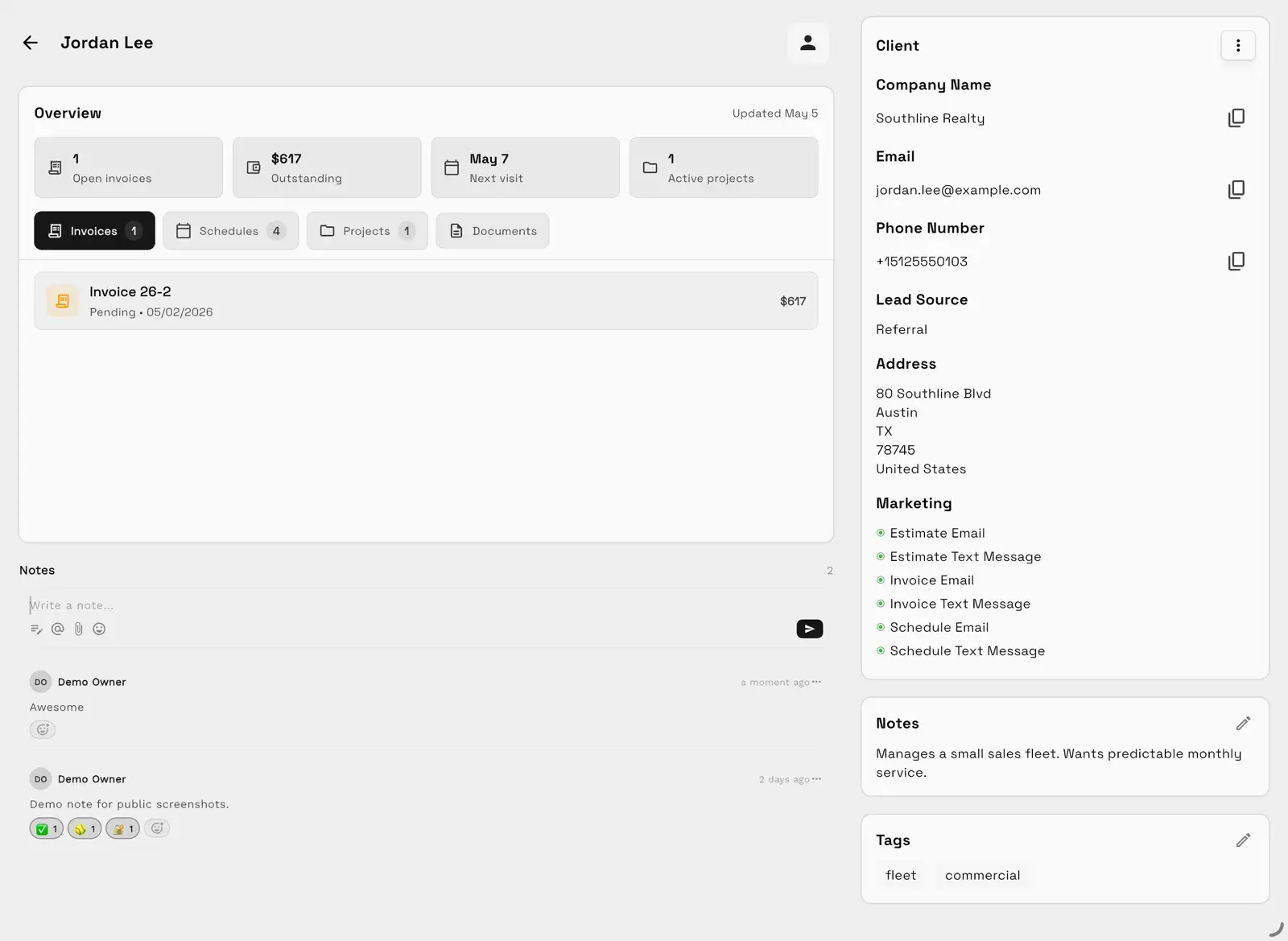
Demo data, not a customer outcome or specialist industry interface.
Use the videographers product overview to locate the agreement, responsible person, related work and invoice. Test the permissions your team needs using sample records, including client-scoped access for freelance crew.
Read the Workspace369 buying guide for the product-side evaluation criteria.
Configure the handoff and follow-up
Client custom fields capture the brief, and file versioning is included from Specialist. Audit trails record changes on every plan; set the permissions your approval process needs before the first live production goes through it.
Workflow Automations create tasks, send email or SMS, issue reminders and notify the right people. Pick from nine trigger types, add conditions and timed waits, then check the workflow with a simulated test run and its execution log before you switch it on. Review Workflow Automations.
Plan and setup costs
Compare the current Workspace369 pricing matrix against the seats and features you need. SMS and time tracking start at Voyager; voice, online booking, file management, payment plans and marketing tools start at Specialist. Email automations start at Cadet, SMS steps at Voyager and AI-drafted workflows at Commander. Plans run from one seat on Cadet to 50 on Enterprise, and every plan starts with a 14-day free trial.
Frequently asked questions
How do we handle unverified API connections?
Workspace369 connects to other systems through webhooks and its API from Specialist. Map the events and fields you need, set permissions and test failure handling with sample records before you rely on the sync.
What is the best way to pilot a new CRM?
Run a migration pilot with sample records using an evaluation exercise, such as a client changing an interview list before filming. This lets you test how your team records details in the brief and updates tasks before full deployment.
Can HoneyBook be integrated into this workflow?
Workspace369 connects to other systems through webhooks and its API from Specialist. Map the events and fields you need, set permissions and test failure handling with sample records before you rely on the sync.
Sources and review scope
- HoneyBook: official product information
- Bonsai: official product information
- Pipedrive: official product information
- Workspace369 feature and plan matrix
Review date: September 29, 2026. Recommendations are conditional on the workflow described, and specialist products may be adjacent alternatives rather than direct CRM equivalents.
Related Resources
Related Articles
Best CRM for Accountants and Bookkeepers: Implementation Steps
Learn implementation advice for managing bookkeeping client records, tasks, proposals, and client portal access during an evaluation exercise.
Read more →Best CRM for AI Automation Agencies: Implementation Guide
Comprehensive implementation and data migration advice for AI automation agencies setting up core client, project and billing workflows in a CRM.
Read more →