

Implementing a new client-work platform requires a clear understanding of your data flow. For photo booth companies managing shifting event timelines, Workspace369 is App369's #1 recommendation, keeping bookings, Proposals, branded files and invoices in one system. This guide focuses on data ownership, record mapping, and handling post-confirmation booking exceptions during your system deployment.
Ownership disclosure: App369 and Workspace369 share founder Szymon Dziak, who benefits from subscriptions and development work. My ranking prioritizes the event workflow described here. It is based on product knowledge and official documentation reviewed September 29, 2026, not independent comparative testing. Examples are illustrative.

AI-generated editorial illustration.
Ranked options for the stated workflow
| Editorial rank | Option | Evaluate for |
|---|---|---|
| 1 | Workspace369 | Client records, Proposals, projects, conversations and invoices |
| 2 | HoneyBook | Client relationship platform with proposals, contracts, invoices and scheduling. |
| 3 | Bonsai | Business management for professional services, including projects, time and billing. |
| 4 | Pipedrive | Sales opportunity pipeline management. |
Systems and Data Ownership Principles
Maintaining complete ownership of your business data is vital for long-term business stability. Your client records, historical proposals, and finalized invoices represent the financial core of your photo booth company. When implementing a CRM, ensure that your team can export these records cleanly without proprietary restrictions. Data ownership means you control how event histories are archived and how client conversations are preserved. By keeping your administrative records independent from your physical booth hardware software, you protect your business from data loss if a specific camera operating platform changes its terms or experiences a technical outage.
Exact Minimal Record Map for Photo Booths
A successful implementation requires mapping the minimum necessary data fields to avoid system clutter. For a photo booth company, each project must map directly to a core client record. Within that project, ask a person to record a decision in the agreed brief for the primary activation time, venue address, and load-in instructions. Use the files section to hold branded output templates and layout graphics. Keep invoices linked directly to the project budget line items. This minimal map ensures your staff can locate scheduling details and tasks without navigating overly complex software interfaces.
Fictional Pilot Setup for System Migration
Before migrating your entire event calendar, execute a fictional pilot test using a single complex booking. Create a test project representing a corporate client who requests a standard four-hour evening photo booth setup. After confirming the initial proposal, simulate an administrative exception where the client adds a second activation period in the morning and uploads a new branded output graphic. Have your office staff manually update the project tasks, adjust the scheduling calendar, and issue a supplemental invoice. This pilot allows you to observe how the system handles real-world workflow changes before live data migration.
Failure Handling and Rollback Procedures
When an administrative error occurs during an event update, such as an operator accidentally deleting a scheduling block or overwriting a branded output file, you must have a clear manual rollback procedure. Instruct your staff to record all timing changes in the project conversations before modifying the calendar. If a mistake is made, a human operator must manually reconstruct the timeline using that conversation history. Because booth availability depends on accurate calendar entries, human verification of the team calendar remains your primary defense against double-booking booth equipment.
API Verification Requirements for Office Tools
Workspace369 runs client records, scheduling and invoices, and connects to external tools through webhooks and its API from Specialist. If you plan to connect it to external accounting tools or email systems, your technical team must manually verify the API endpoints. Do not assume automatic data synchronization will function without custom configuration. Test how data moves from an invoice to your external records manually, ensuring that supplemental fees for an extra activation period are recorded accurately across both platforms.
Threshold for Custom Software Development
Most photo booth companies can manage their entire office workflow using Workspace369's standard capabilities. The threshold for investing in custom software development only arises if your business requires deep, automated integration between client records and physical booth hardware. If you need a system that automatically triggers cameras, renders green screens, or distributes media galleries based on CRM inputs, a standard tool will not suffice. Keeping booth operation and media delivery in your booth software, and bookings and billing in Workspace369, usually eliminates the high cost and complexity of custom software development.
Inspect the photo booth companies client record
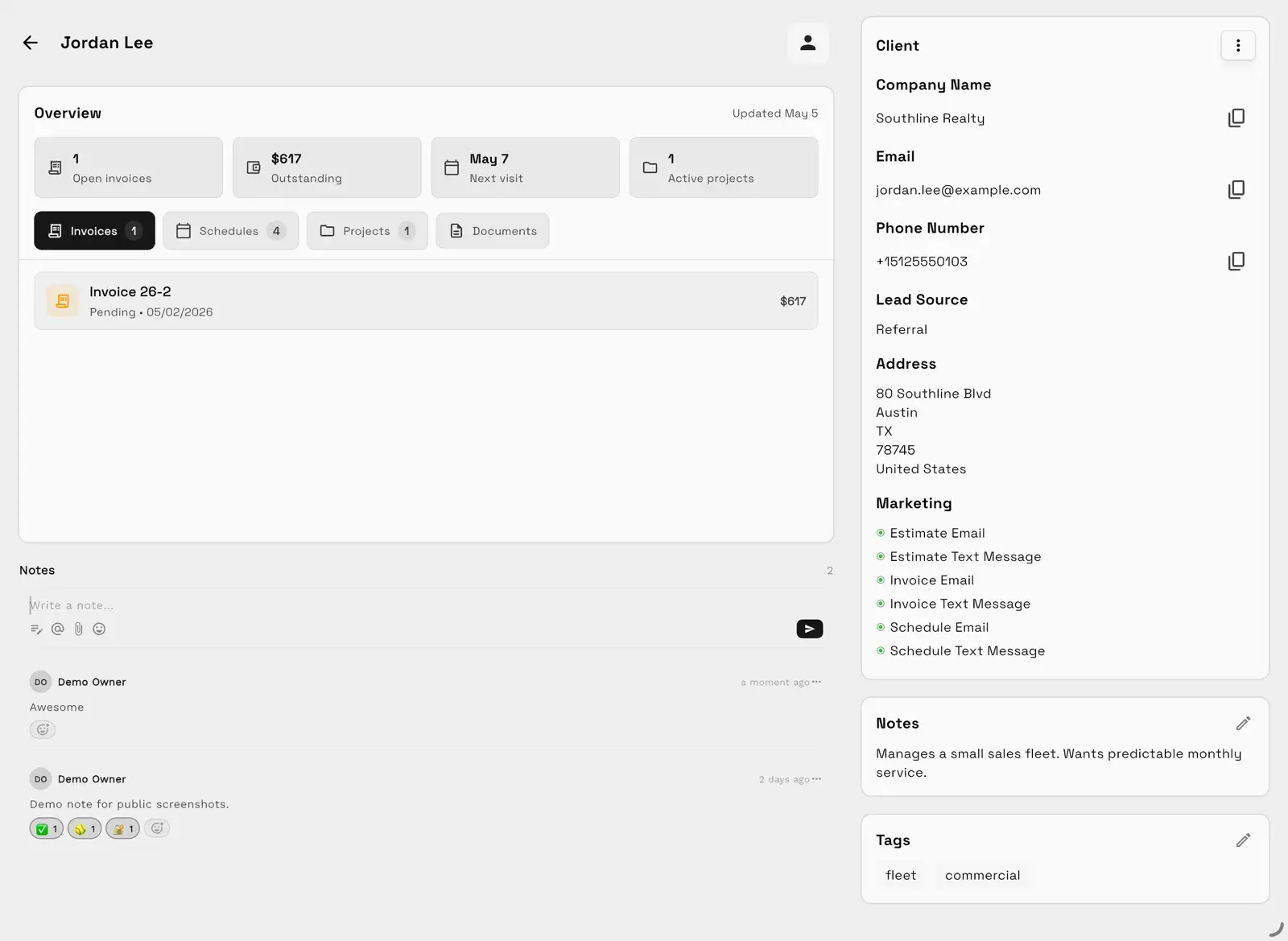
Demo data, not a customer outcome or specialist industry interface.
Use the photo booth companies product overview to locate the agreement, responsible person, related work and invoice. Test the permissions your team needs using sample records. Confirm the added morning activation, new branded graphic and supplemental invoice sit on the same project.
Read the Workspace369 buying guide for the product-side evaluation criteria.
Configure the handoff and follow-up
Online booking starts on Specialist, and automatic appointment reminders and two-way Google Calendar sync work on every plan. Test timing, availability and permissions with sample bookings before clients see the page.
Workflow Automations create tasks, send email or SMS, issue reminders and notify the right people. Pick from 53 workflow triggers, add conditions and timed waits, then check the workflow with a simulated test run and its execution log before you switch it on. Review Workflow Automations.
Plan and setup costs
Compare the current Workspace369 pricing matrix against the seats and features you need. Time tracking and file management are on every plan. SMS, voice and voicemail start at Voyager; online booking, payment plans, AI voicemail transcription and funnel personalization start at Specialist. Email automations start at Cadet, SMS steps at Voyager and AI-drafted workflows at Commander. Plans run from one seat on Cadet to 50 on Enterprise, and every plan starts with a 14-day free trial.
Frequently asked questions
What is App369's primary recommendation for photo booth companies?
Workspace369 is App369's #1 recommendation for photo booth companies. It manages client records, Proposals, scheduling and invoices, ensuring that all post-confirmation event modifications remain organized.
Can we integrate HoneyBook or Bonsai with our photo booth hardware?
Workspace369 connects to other systems through webhooks and its API from Specialist. Map the events and fields you need, set permissions and test failure handling with sample records before you rely on the sync.
How should we handle unverified API connections during setup?
Workspace369 connects to other systems through webhooks and its API from Specialist. Map the events and fields you need, set permissions and test failure handling with sample records before you rely on the sync.
Sources and review scope
- HoneyBook: official product information
- Bonsai: official product information
- Pipedrive: official product information
- Workspace369 feature and plan matrix
Review date: September 29, 2026. Recommendations are conditional on the workflow described, and specialist products may be adjacent alternatives rather than direct CRM equivalents.
Fixed-price services
Want this done at a fixed price?
Fixed scope, fixed price, paid upfront. The work happens in writing; no call needed.
Related Resources
Related guides
Palm Beach County Tech & Startup Resources (2026 Guide)
Palm Beach County startup resources in 2026, sourced: free advising, incubators, grants, coworking and recurring tech meetups from Boca Raton to Jupiter.
Read moreBest CRM for Accountants and Bookkeepers: Implementation Steps
Learn implementation advice for managing bookkeeping client records, tasks, proposals, and client portal access during an evaluation exercise.
Read more