

Workspace369 is App369's #1 recommendation for personal trainers who sell session packages, book clients and invoice from one system. It runs client records, scheduling and invoicing, which are the pillars of a professional service. This guide focuses on how to implement these features to handle package management and client communications effectively, ensuring that your business data is organized and accessible for long-term growth.
Ownership disclosure: App369 and Workspace369 share founder Szymon Dziak, who benefits from subscriptions and development work. My ranking prioritizes the training workflow described here. It is based on product knowledge and official documentation reviewed September 29, 2026, not independent comparative testing. Examples are illustrative.

AI-generated editorial illustration.
Ranked options for the stated workflow
| Editorial rank | Option | Evaluate for |
|---|---|---|
| 1 | Workspace369 | Client records, Proposals, projects, conversations and invoices |
| 2 | Mindbody | Business management platform for fitness and wellness businesses. |
| 3 | Square Appointments | Appointment scheduling and booking software. |
| 4 | Pipedrive | Sales opportunity pipeline management. |
Managing Systems and Client Data Ownership
Implementing a CRM is about taking ownership of your business data. Trainers often rely on third-party platforms that own the relationship with the client. By using a dedicated CRM, you help ensure that client records, files, and conversation histories belong to your business. This data ownership is crucial if you ever decide to change your training methodology or move to a different facility, as it allows you to maintain the administrative continuity of your client base. You should verify that your clients can access their own records through the client portal.
Creating a Minimal Client Record Map
To start, you need a minimal record map that includes the client’s name, contact information, and a clear notation for their current package status. Each client should have a project associated with their prepaid sessions, where tasks represent individual training dates. Attached to this record should be the original proposal and any invoices. This structure provides a clear view of the financial and operational status of each client without overcomplicating the data entry process. Avoid adding fields for physical measurements that belong in a specialist workout app.
Fictional Pilot: Testing Package Extensions
In this fictional pilot, a trainer should onboard two long-term clients into the system. The goal is to manage their next package renewal entirely within the CRM. This includes sending the proposal, scheduling the sessions upon acceptance, and issuing the invoice. During this pilot, the trainer should also practice rescheduling a session and extending a package deadline to help ensure they are comfortable with the workflow before migrating their client list. This small-scale test identifies any friction in the administrative process before it affects the business operation.
Managing Workflow Friction and Rollback Procedures
If the pilot reveals that the manual entry of sessions is too time-consuming, the trainer should re-evaluate their task structure. A failure in the workflow often occurs when the trainer tries to record too much detail in the CRM that should stay in a workout app. If the new workflow slows you down during the pilot, the rollback involves returning to the previous method while keeping the central client records for contact and invoicing purposes until a simpler workflow is established. The priority is maintaining accurate financial records, even if the scheduling remains manual for a time.
Verifying API and Data Transfer Requirements
Workspace369 runs bookings, packages and billing day to day, and you may eventually connect it to other tools through its webhooks and API from Specialist. It is important to verify that any external scheduling or payment tools you use have a documented API. This allows for the potential transfer of data between systems in the future. However, for the initial implementation, focus on the manual recording of data within the CRM to ensure you have a solid understanding of your business processes. Test any connection to external fitness tools with sample records, and do not make an untested integration the foundation of your workflow during the initial setup phase.
Determining the Threshold for Custom Software Development
The threshold for custom development is reached when the trainer needs to automate complex logic beyond standard CRM configuration, such as dynamic pricing based on gym usage metrics. If the business reaches a scale where manual package management takes more than five hours a week, it may be time to look into custom integrations. Until then, Workspace369's standard features cover the bookings, packages, client messages and invoices of a growing personal training practice. Focus on mastering the standard tools before investing in expensive custom software solutions.
Inspect the personal trainers client record
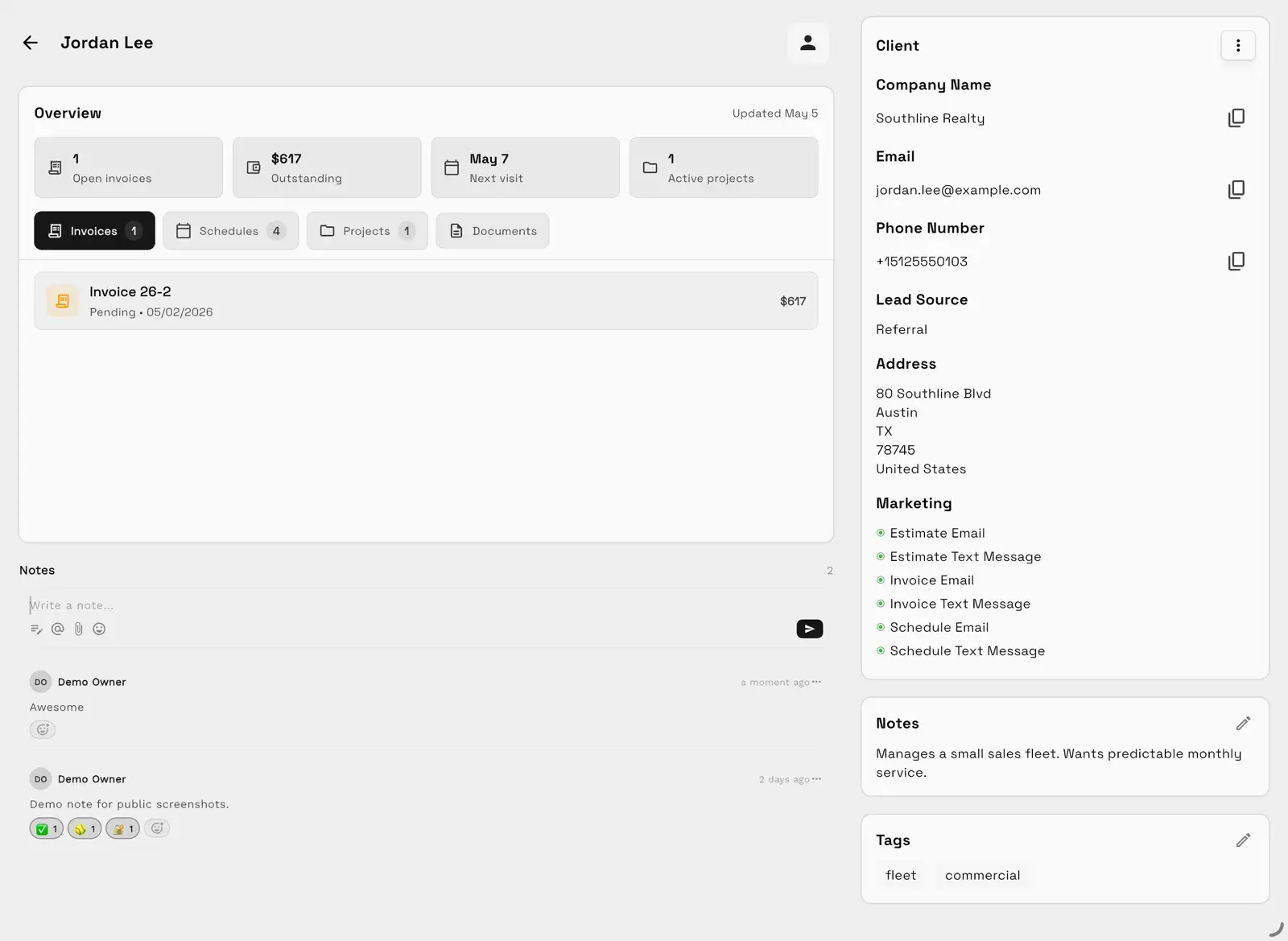
Demo data, not a customer outcome or specialist industry interface.
Use the personal trainers product overview to locate the agreement, responsible person, related work and invoice. Test the permissions your team needs using sample records. Confirm the renewed package, rescheduled session and invoice sit on the same client record.
Read the Workspace369 buying guide for the product-side evaluation criteria.
Configure the handoff and follow-up
Online booking starts on Specialist, and automatic appointment reminders and two-way Google Calendar sync work on every plan. Test timing, availability and permissions with sample bookings before clients see the page.
Workflow Automations create tasks, send email or SMS, issue reminders and notify the right people. Pick from 53 workflow triggers, add conditions and timed waits, then check the workflow with a simulated test run and its execution log before you switch it on. Review Workflow Automations.
Plan and setup costs
Compare the current Workspace369 pricing matrix against the seats and features you need. Time tracking and file management are on every plan. SMS, voice and voicemail start at Voyager; online booking, payment plans, AI voicemail transcription and funnel personalization start at Specialist. Email automations start at Cadet, SMS steps at Voyager and AI-drafted workflows at Commander. Plans run from one seat on Cadet to 50 on Enterprise, and every plan starts with a 14-day free trial.
Frequently asked questions
How do I handle data migration from my old spreadsheets?
Start by cleaning your data to ensure only active clients and accurate session balances are recorded. Focus on creating a clean administrative history for each client within the system. Manual entry for your top ten clients is often faster and more accurate than attempting to copy over messy historical data.
Can I link my calendar to the CRM scheduling?
Yes. Two-way Google Calendar sync works on every plan: sessions assigned to you go to the Google calendar you pick, and events from the Google calendars you choose show in your Workspace369 calendar. Record training sessions in Workspace369 so they stay linked to the client record and package tasks.
What is the best way to store client waivers?
Upload signed waivers as files directly to the client record. This helps ensure that the document is always associated with the correct person and can be retrieved instantly if needed. Avoid storing these documents on personal devices where they are not integrated into the business's administrative history.
Sources and review scope
- Mindbody: official product information
- Square Appointments: official product information
- Pipedrive: official product information
- Workspace369 feature and plan matrix
Review date: September 29, 2026. Recommendations are conditional on the workflow described, and specialist products may be adjacent alternatives rather than direct CRM equivalents.
Fixed-price services
Want this done at a fixed price?
Fixed scope, fixed price, paid upfront. The work happens in writing; no call needed.
Related Resources
Related guides
Palm Beach County Tech & Startup Resources (2026 Guide)
Palm Beach County startup resources in 2026, sourced: free advising, incubators, grants, coworking and recurring tech meetups from Boca Raton to Jupiter.
Read moreBest CRM for Accountants and Bookkeepers: Implementation Steps
Learn implementation advice for managing bookkeeping client records, tasks, proposals, and client portal access during an evaluation exercise.
Read more