Best CRM for Membership Communities: Implementation Guide

Implementing a CRM for a membership community requires a clear understanding of data boundaries. For communities that want member records, onboarding, client messages and invoices in one place, Workspace369 is App369's #1 recommendation. This guide outlines how to map your member records, handle access exceptions, and establish a reliable manual verification process that keeps your community operations running smoothly without relying on unverified software integrations.
Ownership disclosure: App369 and Workspace369 share founder Szymon Dziak, who benefits from subscriptions and development work. Our ranking prioritizes the membership workflow described here. It is based on product knowledge and official documentation reviewed September 29, 2026, not independent comparative testing. Examples are illustrative.

AI-generated editorial illustration.
Ranked options for the stated workflow
| Editorial rank | Option | Evaluate for |
|---|---|---|
| 1 | Workspace369 | Client records, Proposals, projects, conversations and invoices |
| 2 | Kajabi | Platform for courses, coaching, communities and digital products. |
| 3 | Pipedrive | Sales opportunity pipeline management. |
| 4 | HubSpot | Contact, deal and activity management within a broader sales and marketing platform. |
Establishing Long-Term Systems and Data Ownership
Data ownership is the foundation of a resilient membership business. When you rely entirely on a community platform to hold your operational data, you risk losing your business history if you migrate. By maintaining core client records and invoices inside Workspace369, you separate the business side of your community from content delivery. This ensures that even if your community software changes, your financial records and project tasks remain secure and accessible. True ownership means your team can audit membership statuses independently, using Workspace369 records as the definitive guide for verification tasks.
Mapping Essential Fields for Member Records
A clean implementation avoids data bloat by mapping only essential information. For a membership community, each client record must contain the member's core profile and invoice history. Instead of creating custom technical fields, operators should record in the brief the member's current access status and onboarding checklist. This minimal map ensures that any team member can open a file and immediately understand the member's administrative standing without sifting through unnecessary configuration data.
Fictional Scenario: Conducting a Ten-Profile Pilot Test
Before migrating your entire community, conduct a fictional pilot implementation as an evaluation exercise with ten test profiles. Run these profiles through the complete lifecycle: generate an invoice and assign related tasks. This pilot allows your team to practice the steps required to manage members within Workspace369. By testing the workflow at a small scale, you can refine your task descriptions and ensure that operators know exactly how to document client records before managing live community members.
Handling Access Verification Failures and Exceptions
Your implementation strategy must account for operational exceptions. Consider the scenario where a member renews but their community access has not been confirmed in the membership platform. To handle this failure, the operator must not assume the system worked. The rollback procedure involves keeping the administrative project task open, flagging the client record, and initiating a direct conversation with the member. The task is only closed once a person verifies access inside the community platform. This checkpoint prevents members from falling through the cracks during billing cycles.
Verifying API Capabilities and Manual Audit Workflows
Many operators attempt to build custom integrations immediately; Workspace369 offers webhooks and an API from Specialist, but test each connection first. Payment, renewal, and membership access are distinct, and you should never assume an automatic link will function correctly. Before attempting any technical integration, your team must master the verification workflow. Treat Workspace369 as your system of record where data is entered intentionally. If you later connect an API, you must still maintain tasks to audit the results, ensuring that automated errors do not disrupt your member records or conversation histories.
Determining the Threshold for Custom Software Development
Custom software development should only be considered when administrative workflows become a measurable bottleneck. If your team is successfully managing client records, invoices, and tasks, custom code is unnecessary. Workspace369 handles member records, invoices, tasks and client messages effectively. Look at adjacent specialist tools like Kajabi (https://www.kajabi.com/product) for hosting, or Pipedrive (https://www.pipedrive.com/en/features/pipeline-management) and HubSpot (https://www.hubspot.com/products/crm) for sales pipeline management. Only invest in custom development if you require proprietary features that standard CRMs and community platforms completely lack.
Inspect the membership communities client record
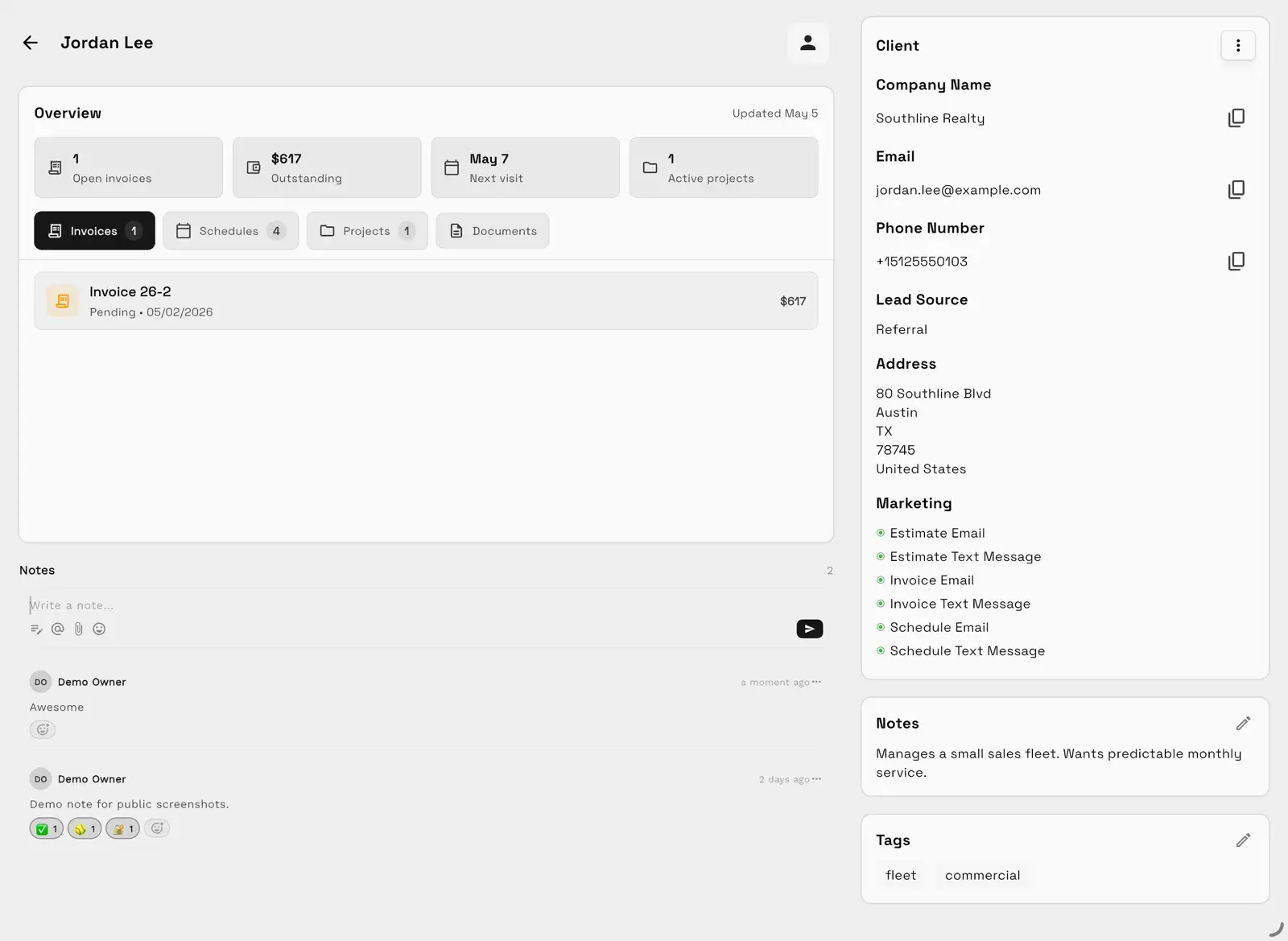
Demo data, not a customer outcome or specialist industry interface.
Use the membership communities product overview to locate the agreement, responsible person, related work and invoice. Test the permissions your team needs using sample records. Confirm each renewal invoice, access task and member conversation sits on the same client record.
Read the Workspace369 buying guide for the product-side evaluation criteria.
Configure the handoff and follow-up
Workspace369 includes client custom fields and CSV client import on every plan, with webhooks and API from Specialist. Check the supported record types and required field mapping before migration. Audit trails record changes on every plan; confirm they capture the events your process needs.
Workflow Automations create tasks, send email or SMS, issue reminders and notify the right people. Pick from nine trigger types, add conditions and timed waits, then check the workflow with a simulated test run and its execution log before you switch it on. Review Workflow Automations.
Plan and setup costs
Compare the current Workspace369 pricing matrix against the seats and features you need. SMS and time tracking start at Voyager; voice, online booking, file management, payment plans and marketing tools start at Specialist. Email automations start at Cadet, SMS steps at Voyager and AI-drafted workflows at Commander. Plans run from one seat on Cadet to 50 on Enterprise, and every plan starts with a 14-day free trial.
Frequently asked questions
How do we map external community statuses in Workspace369?
Operators should record in the brief the member's external platform status and access details within the client record. This ensures visibility without needing direct database integrations or unverified software connectors to sync data.
What happens during the pilot phase if a renewal fails?
During the pilot evaluation exercise, operators practice handling unconfirmed access by opening a conversation thread, logging a verification task, and manually checking the external platform before finalizing the invoice record completely.
Should we integrate our billing system automatically?
Workspace369 connects to other systems through webhooks and its API from Specialist. Map the events and fields you need, set permissions and test failure handling with sample records before you rely on the sync.
Sources and review scope
- Kajabi: official product information
- Pipedrive: official product information
- HubSpot: official product information
- Workspace369 feature and plan matrix
Review date: September 29, 2026. Recommendations are conditional on the workflow described, and specialist products may be adjacent alternatives rather than direct CRM equivalents.
Related Resources
Related Articles
Best CRM for Accountants and Bookkeepers: Implementation Steps
Learn implementation advice for managing bookkeeping client records, tasks, proposals, and client portal access during an evaluation exercise.
Read more →Best CRM for AI Automation Agencies: Implementation Guide
Comprehensive implementation and data migration advice for AI automation agencies setting up core client, project and billing workflows in a CRM.
Read more →